Summary
Statey alternatives for Xero customer statements range from Xero's own free manual statements to automated apps that add chasing and late fees. Paidnice is the best fit for growing businesses that want statements combined with automated reminders and optional late fees, starting at $69 a month (£49). Statey sends statements only, so switch when statements need to chase or charge.
- Free option: Xero's built-in customer statements are free and fully manual, with no automated send schedule and no age analysis.
- Price: Paidnice starts at $69 a month (£49) for 150 invoices, priced by invoice volume, not per Xero organisation like Statey and not per user.
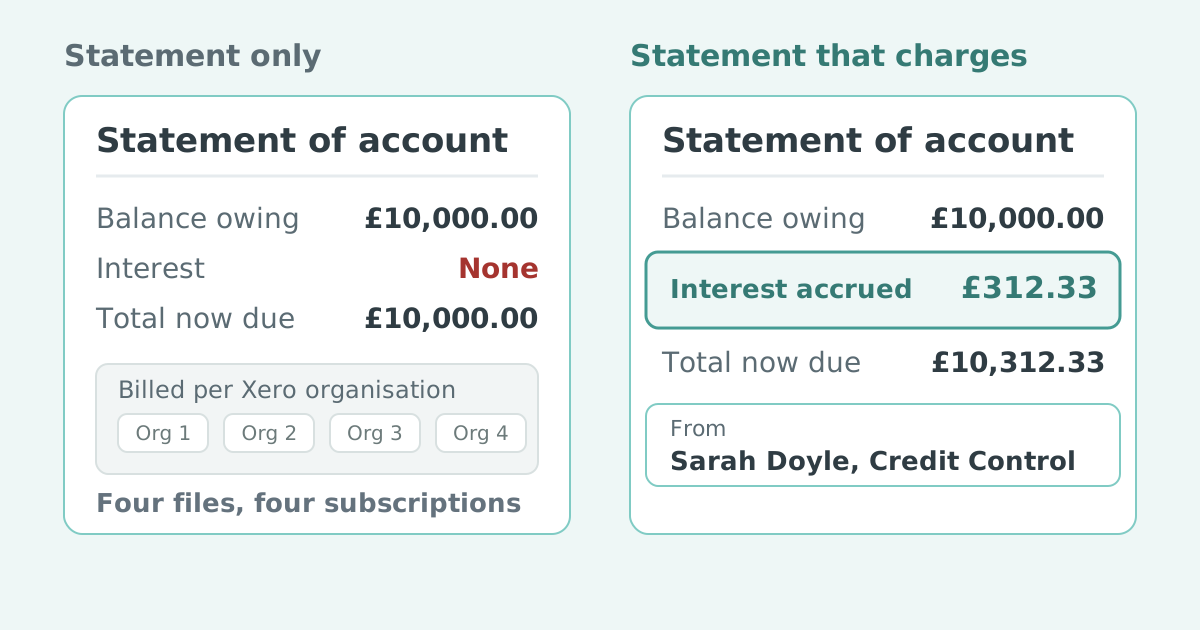
- What Statey does not do: Statey sends statements only: it does not chase the balance it shows and raises no charge on it.
What does Statey do to a Xero statement, and what does it not do?
Statey is a Xero-only plugin that adds age analysis, send schedules and delivery tracking to a Xero customer statement, billed per Xero organisation. It does not chase the balance or charge interest on it.
Statey's own description is narrow on purpose: age analysis, automated sending schedules and delivery tracking on your Xero customer statements, with 30, 60 and 90 day buckets you set yourself. The age analysis has four calculation methods, pairing invoice date or due date with calendar months or exact days, which is more control than most full receivables suites offer.
What is missing is everything after the send. No reminder sequence, no escalation, no late fee, no interest, no payment link on the statement. The customer receives an accurate picture of what they owe, with no request for payment attached. Our guide to adding 30, 60 and 90 day ageing to Xero statements covers the same job from the other side.
Is StateyApp different from Statey?
No. StateyApp and Statey are the same Xero statement plugin, sold from the statey.app domain and listed on the Xero App Store as Statey. People search both spellings, and every price, tier and limit on this page applies to both.
Statements are sent because invoices sit unpaid. Xero Small Business Insights measures how long that takes across five markets.
| Country | Days to be paid | Year on year |
|---|---|---|
| Australia | 20.3 days | -4.3 days |
| New Zealand | 23.2 days | -0.9 days |
| US | 29.1 days | +1.6 days |
| UK | 29.3 days | -0.3 days |
| Canada | 29.5 days | +1.9 days |
Source: Xero Small Business Insights, June 2026. See the full data on the Paidnice accounts receivable statistics dashboard.
The tools below differ in what they do once the statement is out.
What are the alternatives to Statey for Xero, and who is each one for?
Two alternatives sit around Statey: Xero's own manual statements, free and already in the ledger, and Paidnice, for statements that carry interest and post it to the Xero ledger from $69 a month (£49).
Statey, if you stay
The incumbent, and the right answer for a real segment. A founder-run team based in the USA and South Africa, on the Xero App Store since May 2022, doing one job.
- Best for: a business that wants an accurate, well-aged statement out on a schedule and intends to do the chasing itself.
- Key difference: the deepest statement configuration in the Xero ecosystem, and nothing beyond the send.
- Pricing: three tiers at $10, $25 and $50 per Xero organisation a month, or $110, $275 and $550 a year on annual billing.
The limitation, Statey. It will not chase, escalate or raise a charge, so the statement informs and never collects. Billing is per Xero organisation, so a bookkeeper on four files pays four times. Xero only, with no QuickBooks option.
Xero's own customer statements
The do-nothing baseline, and worth pricing honestly before you buy anything. It costs nothing extra and it is already in the ledger you use.
- Best for: a small ledger where a statement goes out occasionally and somebody remembers to send it.
- Key difference: Xero generates the statement, and every part of sending it is manual.
- Pricing: included in your Xero subscription.
Xero can produce a statement and email it to a batch of customers. It cannot repeat that on a schedule, filter to only the customers who owe you, target a customer group, or skip weekends, and it carries no age-analysis breakdown.
The request to auto-email statements was posted to Xero's product ideas board on 13 November 2015 and holds 1,172 votes, with the status "In discovery". Xero's community manager Kelly Munro replied on 5 August 2026 that discovery is continuing.
The limitation, Xero on its own. Everything below generating the PDF is manual and all-or-nothing, every month. There is no schedule, no ageing table and no way to send only to the customers who owe you.
Paidnice
Accounts receivable automation that enforces your payment terms, on Xero and QuickBooks Online, for any business, from its first invoice up to $50m a year, or 50,000 invoices a year. Priced fairly, with no contracts or lock-ins.
- Best for: a business whose statements are accurate and ignored, and that wants the balance to carry interest and a named sender.
- Key difference: interest charged against the whole overdue balance, recalculated at the moment the statement sends, posted to the Xero or QuickBooks ledger.
- Pricing: $69 / £49 a month on Essentials for 150 invoices and 2 users, up to $799 / £599 on Pro 4,000. Full ladder below.
The limitation, Paidnice. If a statement is the whole job, this is the wrong buy. Statey's entry tier is cheaper, it gives you a choice of four age-analysis calculation methods where Paidnice gives you the buckets and one model, and it includes unlimited users on every tier where Essentials includes two. Xero and QuickBooks Online only.
Statey alternatives compared: what does each one charge for?
Statey charges per Xero organisation, Xero's own statements cost nothing extra, and Paidnice charges by invoice volume, so the Paidnice bill follows what you send rather than how many files you keep.
| Decision fact | Statey | Xero built-in | Paidnice |
|---|---|---|---|
| Priced by | Per Xero organisation | Included in Xero | Invoice volume |
| Reason to choose it | Cheapest, and the deepest statement configuration | Free, and enough for a light ledger | Interest and fees raised on the ledger |
| From, a month | $10 (£8) | No extra cost | $69 / £49 |
| Four Xero organisations | Four subscriptions | Included | One plan plus add-on |
| Revenue fit | Any | Any | Any size up to $50m a year, or 50,000 invoices a year |
| Age analysis you control | ✅ Safe Four methods | ❌ None | ✅ Safe Your buckets |
| Automated send schedule | ✅ Safe | ❌ None | ✅ Safe |
| Chases overdue invoices | ❌ None | ⚠️ Caution One schedule | ✅ Safe |
| Interest on the statement balance | ❌ None | ❌ None | ✅ Safe Recalculated at send |
| Late fee per overdue invoice | ❌ None | ❌ None | ✅ Safe Per group |
| How you try it | 32 days free, no card | Already in Xero | First 20 actions free, no card |
If you only want the statementStay on Statey. Four age-analysis methods, per-group schedules, delivery statistics and unlimited users, from a lower entry price than anything else here. Budget it per Xero organisation.
If you send a batch a few times a yearStay on Xero. Nothing extra to pay, and the manual batch is bearable at low volume. Revisit when you notice you have skipped a month.
If you need credit checks or a collections pathwayStatey carries no credit bureau feed. Paidnice runs credit checks through Creditsafe on its Custom plan; Essentials and Pro rate payers from their own payment history instead.
If accurate statements get ignoredLook at Paidnice. Interest against the overdue balance, recalculated at send and raised on the Xero or QuickBooks ledger, from $69 a month (£49).
Consolidation, senders, users and ratings
Four facts that decide a shortlist rather than a purchase: whose statement consolidates a parent and its children, who escalates to a named sender, how many users you get and how each one is rated.
| Decision fact | Statey | Xero built-in | Paidnice |
|---|---|---|---|
| Consolidated parent and child | ❌ None | ⚠️ Not published | ✅ Safe |
| Escalates to a named sender | ❌ None | ❌ None | ✅ Safe Sender profiles |
| Users included | Unlimited, every tier | Your Xero users | 2, then unlimited |
| Rated | 4.7 from 13, Xero App Store | Not applicable | 5.0 from 83, Xero App Store |
The vendor documents the capability and it holds at volume without a workaround.
It works, and it degrades. Xero's own reminders run one schedule at organisation level against every invoice marked as sent.
The capability is absent from the vendor's documented feature list. Statey states that it does statements and nothing further.
The vendor documents nothing either way, so we have assumed nothing. A statement-level interest charge appears nowhere in its materials.
Prices, ratings and capabilities are taken from vendor materials and the Xero App Store. Verify current pricing with each vendor before you budget.
What does Statey cost when you run four Xero organisations?
Statey across four Xero organisations is four subscriptions, not one, because Statey bills each Xero organisation separately at $10, $25 or $50 a month. That is the figure most comparisons leave out.
Statey publishes three tiers and bills each one per Xero organisation per month. Starter is $10 a month and gives you age analysis, delivery statistics, the Don't Send list and unlimited users. Standard is $25 and is where the Statey watermark comes off, along with the Excel download, multi-currency and Smart Recipients Lists. Pro is $50 and adds multiple schedules, a self-service custom sending domain and an API with webhooks. Annual billing costs $110, $275 or $550 a year, about 8% less than paying monthly.
Two things follow from the denominator. A bookkeeper running four client files on Standard pays four subscriptions, not one, so four times the tier price. And the watermark comes off at the middle tier, so a comparison that names only the top tier overstates what removing it costs.
Statey bills in your local currency. Its pricing page lists USD, GBP, ZAR, AUD and NZD, set from your location, with USD everywhere else. Starter is $10, £8, R199, AU$15 or NZ$15 a month. Third-party comparisons often publish pound figures for the entry and top tiers and skip the middle one (£18), which is how a three-tier product gets described as two.
Take the tier structure and the per-organisation denominator as the reliable part. Read the price for your currency off Statey's pricing page before you budget. The annual cost at three business sizes, against Xero's own manual statements, is in the full Statey pricing comparison.
Paidnice uses a different denominator again: invoice volume, so seats, turnover and the number of Xero organisations do not move the bill. Paidnice counts invoices, with a multi-entity add-on at $29 / £19 an entity for groups running several Xero organisations. Running one process across several files is covered in credit control across multiple Xero companies.
The full Paidnice price ladder
| Plan | Invoices a month | USD | GBP |
|---|---|---|---|
| Essentials | 150, 2 users | $69 | £49 |
| Pro 300 | 300 | $99 | £74 |
| Pro 600 | 600 | $179 | £129 |
| Pro 1,000 | 1,000 | $279 | £199 |
| Pro 4,000 | 4,000 | $799 | £599 |
| Custom, from | Above 4,000 | $999 | £749 |
| Multi-entity add-on | Per entity | $29 | £19 |
Every currency is a hard-coded local price, never a conversion. Pro tiers between 1,000 and 4,000 invoices sit on the pricing page.
What do you give up when you leave Statey?
Leaving Statey costs you four age-analysis calculation methods, Smart Recipients Lists, delivery statistics, an Excel download and unlimited users on every tier. Statey configures a statement more deeply than most full receivables suites bother to, so a switcher loses several of those controls.
- Four age-analysis calculation methods. Invoice date or due date, paired with calendar months or exact days. Most tools give you one model and let you move the bucket boundaries.
- Smart Recipients Lists. A send list built from a Xero contact list plus filters, on the middle tier and up.
- Delivery statistics. A record of who received a statement and who did not, which is a genuinely useful thing to have when a customer says it never arrived.
- Excel download of the statement, alongside the PDF, from the middle tier.
- Unlimited users on every tier, including the cheapest one.
- A custom sending domain on the top tier, which you verify yourself through DNS.
Two of those have direct equivalents elsewhere. Paidnice sends from your own authenticated domain on Pro, verified once so any address on it works, and Pro includes unlimited users. The ageing methods and the Excel download have no equivalent. If either one decides your month, staying on Statey is the right call.
What does Paidnice put on a statement that Statey does not?
Paidnice charges interest against the whole overdue balance, recalculates it at the moment the statement sends, and consolidates parent and child accounts onto one statement.
Statement interest is a charge against the customer, not the invoice. A late fee attaches to one overdue invoice. A statement interest charge runs against everything a customer owes, which is the number the statement is already showing them. Adjust for Credit calculates it on the net balance when the customer is holding a credit note.
It recalculates at send. Accrued interest is recomputed at the point the statement goes out rather than fixed at the last policy run, so the figure your customer opens is accurate that morning. The manual alternative is an interest invoice raised once and stale inside a week.
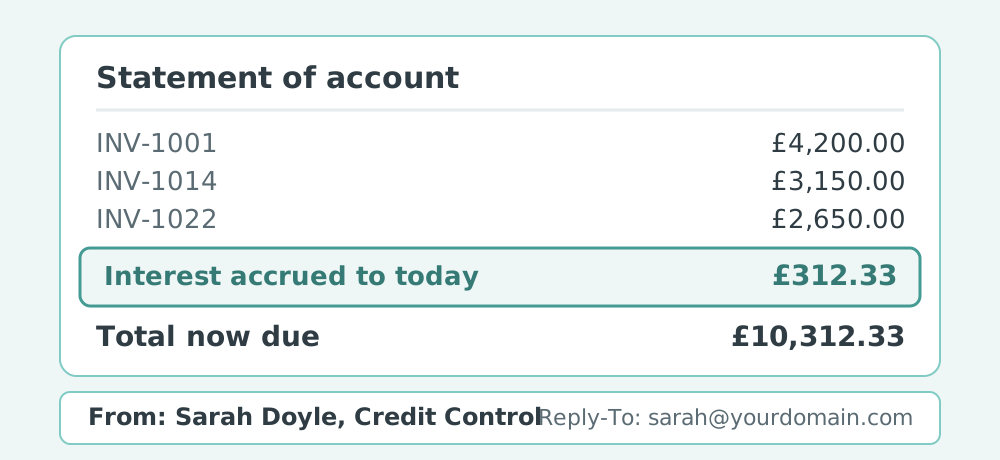
Parent and child accounts consolidate onto one statement. A parent-customers-only setting sends the statement to the parent account and pulls in every child account's open invoices, so a head office receives one balance for all its branches instead of one statement per child. Statey sends one statement per Xero contact.
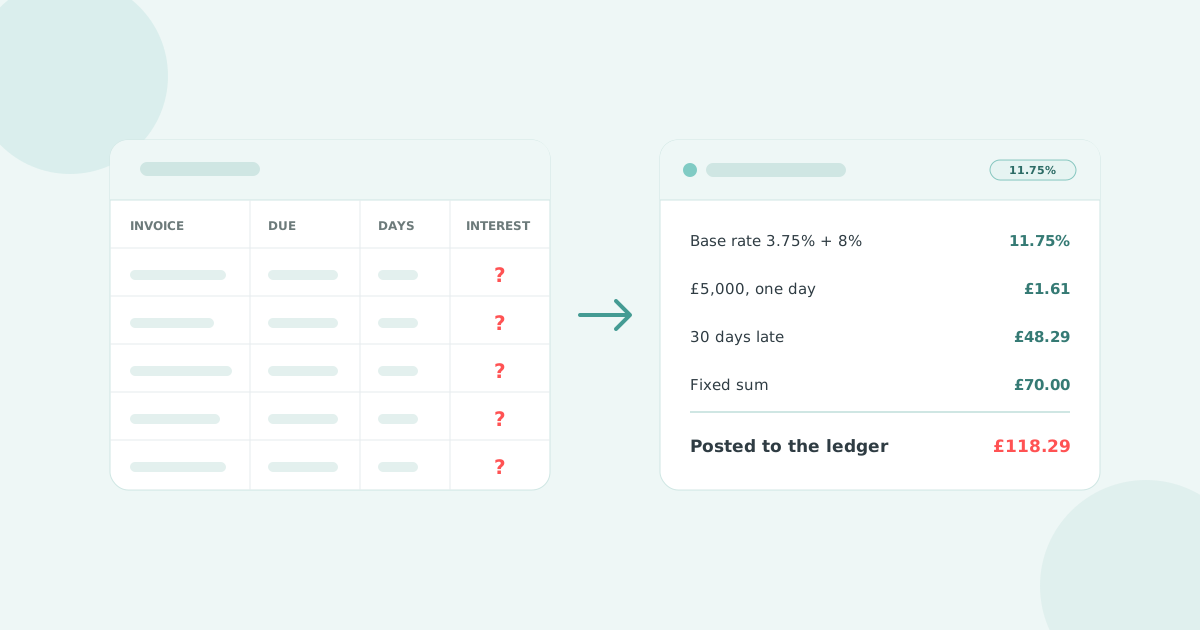
The UK rate stays right on its own. A Bank of England base rate toggle applies the correct base rate for each period an invoice spans, and the statutory rate is fixed in six-month blocks, so the charge does not need a manual edit each time the rate moves. Compounding is a toggle, on by default. More on the mechanics in auto-sending statements with calculated interest.
The charge lands on the ledger. It is raised in Xero or QuickBooks Online as Draft or Approved, your choice, with its own description and income account. Only a posted invoice enters your customer's payables system and their payment run, which is where the charge gains its leverage.
Sender profiles move the escalation up a level. Each policy gets its own From name, From address and Reply-To, so accounts@ handles the due date, a named credit controller takes over at 7 to 14 days, and a director signs the message at 21 days and on late fees. Where the charge belongs in that sequence is covered in our dunning process guide.
Paidnice insightPaidnice launched in 2022 to generate late fees, so charging is the original job rather than a module added later. Policies sit under customer groups, so one group can run base rate plus a percentage while another runs a flat fee and a third runs nothing.
How do you try Statey and Paidnice before you pay?
Statey gives you 32 days free with no card. Paidnice has no trial and does have a free action period: the first 20 actions, no time limit, no card.
Statey. A 32-day free trial with no credit card, taken from the Xero App Store listing or the Statey site. That is long enough to send a full monthly cycle and see who actually opened it.
Paidnice. Signing up is free and the first 20 actions are free, with no time limit and no credit card. Nothing expires while you are still deciding, and no demo is needed, so you can point it at your own overdue ledger and watch what a statement with interest on it does to one real customer.
Xero on its own. Already in your subscription. Send one statement batch by hand this month and time it, so you have a real number to compare the paid options against.
How to choose between Statey, Xero on its own, and Paidnice
Stay on Statey if a statement is the whole job. Use Xero on its own if you will send them by hand. Move to Paidnice if the statement needs to charge.
If the shortlist is wider than these three, the whole Xero field is in credit control software for Xero, and what the category has to cover is on our credit control software page. For the charge itself, read how much you can charge for late fees and, for UK debts, late payment fees in the UK.
Questions people ask about Statey alternatives
Seven questions decide this switch: what Statey chases, what several Xero organisations cost, what Xero can do alone, who gets the send, and whether a statement can carry a charge.
Does Statey chase invoices?
No. Statey sends customer statements with age analysis, delivery tracking and a send schedule, and stops there. It has no reminder sequence, no escalation, no late fee and no interest, so the statement reports the balance without asking for it. Chasing needs a second tool, or a different one.
What is the difference between a statement tool and a credit control tool?
A statement tool sends the balance and stops. A credit control tool chases it, escalates it and can charge interest on it. Statey is the first. Paidnice is the second, which is why it costs more.
How much does Statey cost for a bookkeeper with several client files?
Statey is billed per Xero organisation per month, so the bill multiplies by the number of files you run. Four organisations on the middle tier is four subscriptions, not one, so four times the tier price. The three tiers are $10, $25 and $50 a month, or $110, $275 and $550 a year on annual billing, and Statey bills in your local currency.
Can Xero send customer statements automatically?
No. Xero can generate a statement and email it to a batch of customers, and it cannot put that on a schedule, filter to only the customers who owe you, target a customer group or skip weekends. The request to auto-email statements was posted to Xero's product ideas board on 13 November 2015, holds 1,172 votes and sits at "In discovery".
Can I send Xero statements only to overdue customers?
Not in Xero. The statement run goes to the batch you pick and cannot filter to the customers who owe you. Statey's Smart Recipients Lists build that filter from the middle tier up, and Paidnice sends per customer group.
How do I try a Xero statement add-on before paying?
Statey publishes a 32-day free trial with no credit card. Paidnice has no free trial and does have a free action period: signing up is free, the first 20 actions are free, there is no time limit and no card. Xero's own statements need no trial, because they are already in the subscription you pay for.
Can you add late fees or interest to a Xero statement?
Not in Xero, and not in Statey. Paidnice charges interest against the whole overdue balance on the statement, recalculated at the moment it sends, and raises the charge in Xero or QuickBooks Online as a Draft or Approved invoice with its own income account. A separate invoice late fee can run per overdue invoice at the same time.

Stop chasing invoices.
Start getting paid.
Paidnice is accounts receivable automation that enforces your payment terms, trusted by thousands of businesses on Xero and QuickBooks. Credit control and debtor management, run for you.
Try it Now - It's FreeNo card required.