

 Read by Denym Bird7 min
Summary
Once an overdue invoice is being chased, it takes 2 to 3 follow-ups on average to get paid, in Paidnice's analysis of invoice data from over 1,000 customers. 4 in 10 are paid after the first and 8 in 10 by the fourth. Our suggestion is 3 to 5 follow-ups, because each one after the fourth or fifth adds little.
- The first reminder: About 32% of overdue invoices are paid within 3 days of the first overdue reminder.
- Each extra reminder: Against no reminder, the first overdue reminder is followed by about 19 more invoices in every 100 paid within 7 days, the second about 12 more, and the third to eighth 5 to 7 more.
- The limit: 1 in 10 chased invoices is not paid within 180 days, however many reminders it gets, so the sequence needs a stated end and a next step.
- The fix: Paidnice runs the whole sequence from Xero or QuickBooks Online, with email, SMS and escalation steps on a schedule you set once.
You sent the invoice, the due date passed, and you sent a polite nudge. A week on, nothing. You open the email again and wonder whether a second reminder looks pushy, or whether a third is the one that finally lands.
In the video: How many follow-ups does an invoice need? (0:34), how fast do customers pay after a reminder? (1:24), why do most overdue invoices get no reminder? (2:06), how much does each extra reminder add? (3:05), what to do (3:53).
Short answer: our suggestion is 3 to 5 follow-ups after the due date, about a week apart, then a call. In the data, 8 in 10 chased invoices are paid by the fourth or fifth follow-up. We have not tested the one-week spacing.
How many payment reminders does an overdue invoice need?
Once an overdue invoice is being chased, it takes 2 to 3 follow-ups after the due date on average to get paid (median 2), in our analysis of invoice data from over 1,000 Paidnice customers. A follow-up is any reminder, SMS, escalation, late fee email or statement sent after the due date.
Paidnice customers are the businesses that use Paidnice. Their own customers, the people who owe the invoices, are called payers on this page.
4 in 10 are paid after the first, 6 in 10 by the second and 8 in 10 by the fourth. 1 in 10 is not paid within 180 days.
Share of chased overdue invoices paid, by follow-up number
Cumulative, followed for 180 days. A follow-up is any reminder, escalation, SMS, late fee email or statement after the due date.
- After follow-up 140%
- By follow-up 263%
- By follow-up 372%
- By follow-up 479%
- By follow-up 582%
- By follow-up 6 to 988%
- By follow-up 10 or more91%
Source: our analysis of invoice data from over 1,000 Paidnice customers.
Counting email reminders alone, of reminded invoices 6 in 10 are paid after one reminder, 8 in 10 after two and 9 in 10 after four. The median is 1 reminder and the 90th percentile is 3. The follow-up counts above include SMS, escalations, late fee emails and statements.
Our suggestion is 3 to 5 follow-ups after the due date: in the data, 8 in 10 chased invoices are paid by the fourth or fifth, and each later one adds little. The one-week spacing between them is our suggestion, not something we tested. The wider picture is in our credit control statistics.
How much more payment does each extra reminder add?
Against no reminder, the first overdue reminder is followed by about 19 more invoices in every 100 paid within 7 days, in Paidnice data, and later reminders by about 3 more. Detail by reminder number: the second about 12 more, the third to eighth 5 to 7 more and later ones about 3 more.
| Overdue reminder | Paid within 3 days of it | Extra paid within 7 days |
|---|---|---|
| 1st | 32% | About 19 more in 100 |
| 2nd | 26% | About 12 more in 100 |
| 3rd | 22% | 5 to 7 more in 100 |
| 4th | 19% | 5 to 7 more in 100 |
| 5th | 18% | 5 to 7 more in 100 |
Source: our analysis of invoice data from over 1,000 Paidnice customers. Extra paid is in every 100, against no reminder.
The first two overdue reminders do most of the work
Extra invoices paid within 7 days of each reminder, in every 100, against no reminder.
- 1st overdue reminder+19 in 100
- 2nd+12 in 100
- 3rd to 8th+5 to 7 in 100
- 9th or later+3 in 100
Source: our analysis of invoice data from over 1,000 Paidnice customers.
How fast do customers pay after a payment reminder?
Overdue invoices are paid about 3 times as often on the day a reminder is sent as comparable overdue invoices with no reminder (about 12 in 100 against about 4 in 100), in Paidnice data. Businesses chose which invoices to remind, so this is a strong short-term pattern, not a controlled test. It is one of the credit control myths our data busts: the belief that chasing changes nothing.
Within a week, 38% are paid against 22% with no reminder.
Overdue invoices are paid 3 times as often on a reminder day, and the gap lasts a week
Share of unpaid overdue invoices paid on each day, from the send day. Comparison invoices are at the same days overdue with no reminder.
Source: our analysis of invoice data from over 1,000 Paidnice customers.
Of payments made within 14 days of a reminder, half arrive within 3 days and 1 in 4 on the same day. Send day matters too: we measured it by weekday in the best day to send a payment reminder.
A reminder does not drive payers away: overdue invoices are paid 3 times as often on the day a reminder is sent, in Paidnice data.
Why do most overdue invoices get no reminder after the due date?
85% of invoices that go overdue get no reminder after the due date, in our analysis of invoice data from over 1,000 Paidnice customers.
2 in 3 reminders go out on or before the due date (25% before, 40% on the day). Most sequences are built around the due date and then stop.
2 in 3 reminders go out on or before the due date
Share of all reminders by when they are sent, in businesses that send 100 or more reminders.
- Before the due date
- On the due date
- After the due date
Source: our analysis of invoice data from over 1,000 Paidnice customers.
When do more payment reminders stop working?
For a payer with no other overdue invoice, a reminder is followed by about 26 more invoices in every 100 paid within 7 days, in Paidnice data. For a payer with 4 or more overdue invoices, it is only 1 to 4 more in every 100.
A reminder is followed by only 1 to 4 more invoices in every 100 paid once a payer has 4 or more overdue
Extra invoices paid within 7 days of a reminder, in every 100, against no reminder.
- No other overdue invoice+26 in 100
- 4 or more overdue invoices+1 to 4 in 100
Source: our analysis of invoice data from over 1,000 Paidnice customers.
Once a payer has 4 or more overdue invoices with you, another automatic email is followed by only 1 to 4 more invoices in every 100 paid within 7 days, in Paidnice data. Change what you do: a call, a payment plan or a hold on new work.
Two early warnings:
- The first reminder. In Paidnice data, payers who pay within 3 days of their first overdue reminder leave 2% of later invoices unpaid, against 9% for the rest.
- A bounce. A bounced reminder doubles the chance an invoice is still unpaid at 75 days (13% against 6%). Fix the contact the same day.
A bounced reminder doubles the chance of an unpaid invoice
Share of reminded invoices still unpaid 75 days after the due date.
- Reminder bounced13%
- Reminder delivered6%
Source: our analysis of invoice data from over 1,000 Paidnice customers.
If a payer goes quiet on every channel, see when a customer ignores invoice reminders.
What happens after the last payment reminder?
An invoice 7 days overdue has a 1 in 5 chance of still being unpaid 180 days later, in Paidnice data. At 30 days overdue the chance is 2 in 5, and at 90 days it is 3 in 4.
The full curve by days overdue is in how long payers take to pay after the due date.
An invoice still unpaid 90 days after its due date has a 4 in 10 chance of being paid within a year. About 6 in 10 are not paid within a year.
A payment reminder sequence needs a stated end and a next step the payer can see coming:
- Final notice with the date you will escalate.
- Phone call. Have a person call and ask what is blocking payment.
- Late fee or interest. A fee gives the payer a reason to pay this invoice first. Apply it automatically and waive it on purpose for a good payer who slipped once. UK businesses can charge statutory interest at 8% plus the Bank of England base rate, plus a fixed sum of £40, £70 or £100.
- Hold on new work, then a letter before action and collections.
How should you space your payment reminders?
Our suggestion is 3 to 5 follow-ups after the due date, about a week apart, each firmer than the last, with a switch of channel before the end of the sequence. In the data, 8 in 10 chased invoices are paid by the fourth or fifth follow-up. The one-week spacing is our suggestion; we have not tested it.
A week is long enough to see whether each step worked: half of the payments that follow a reminder arrive within 3 days.
Half of the payments that follow a reminder arrive within 3 days
Share of payments made within 14 days of an overdue reminder, by the day they arrive.
- Same day
- Days 1 to 3
- Days 4 to 14
Source: our analysis of invoice data from over 1,000 Paidnice customers.
The one-week spacing, the firmer wording and the channel switch in the table below are our recommendation. We have not isolated their effect.
| Step | When | Channel | Note |
|---|---|---|---|
| Pre-due | 3 days before due | Invoice attached, pay link | |
| Due | On the due date | ||
| Overdue 1 | 3 days after due | Asks for a payment date | |
| Overdue 2 | 7 days after due | Email plus SMS | |
| Overdue 3 | 14 days after due | Cc 2nd contact, names fee | |
| Final notice | 21 days after due | Email and a call | States escalation date |
Wording for each step is in our invoice payment reminder email templates and SMS payment reminder templates.
Doing this manually costs time: UK businesses affected by late payment spend an average of 86 hours a year chasing it, in research for the UK Department for Business and Trade.
How do you set up a payment reminder sequence in Paidnice?
After a business turns on reminders, 71% collect more invoices within 30 days, in our analysis of invoice data from over 1,000 Paidnice customers.
On-time payment rises from 53.4% to 58.5%. A matched test against similar businesses gives a smaller gain, about 2 more invoices in every 100 paid on time. Paidnice connects to Xero or QuickBooks Online and runs the sequence on every invoice your policy covers.
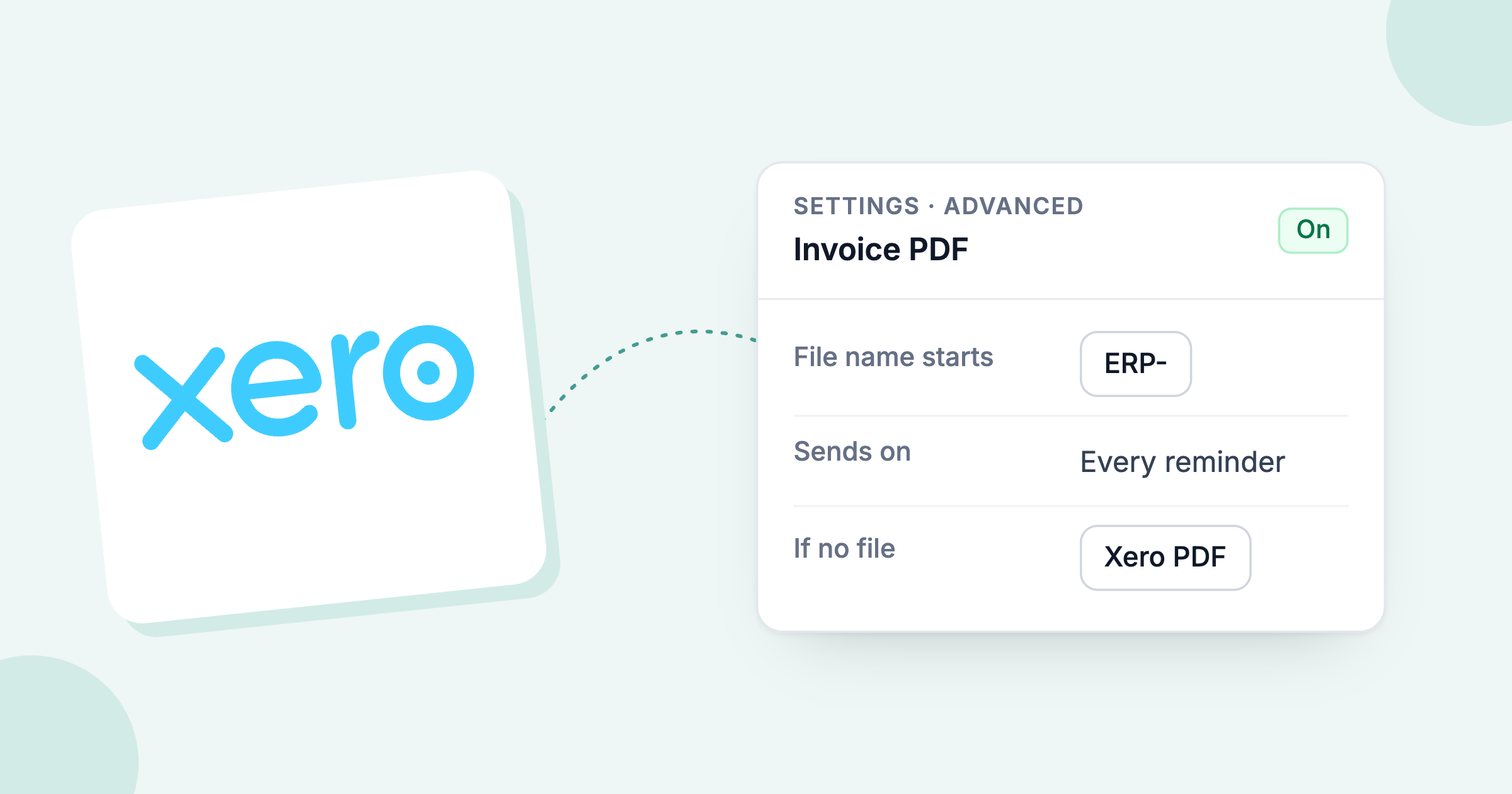
- Connect your ledger with the quick start guide.
- Build the sequence as a policy: reminders before, on and after the due date, timed in days or weekdays. See sending invoice emails and reminders.
- Add an SMS step at the second or third overdue reminder: SMS reminders.
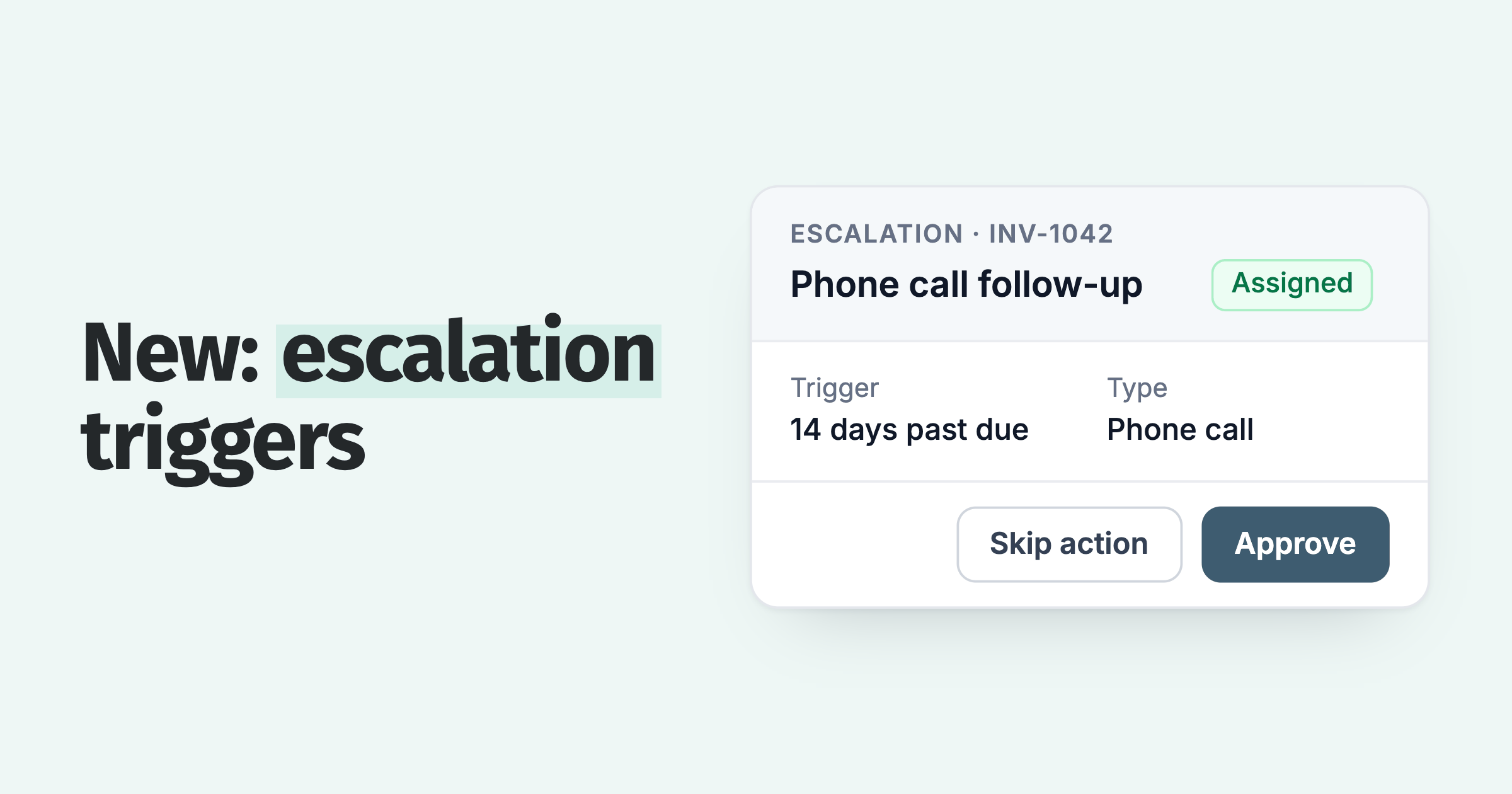
- Add an escalation at the end, so a person gets a task to call: escalations.
- Run different sequences for different customers with groups and policies.
Late fees are optional. You can run reminders and statements alone and add a fee later, as a reason for customers to pay your invoice first.
See the email and SMS reminders feature, or book a demo and we will set the sequence up with you.
How we measured payment reminders
We measured reminders on credit invoices, with payment checked 75 days after the due date, across invoice data from over 1,000 Paidnice customers.
- Base: credit invoices: payment terms of 1 day or more, not paid on or before the issue date.
- Outcome: paid or unpaid 75 days after the due date. The follow-up figure follows each chased invoice for 180 days; a follow-up is any reminder, escalation, SMS, late fee email or statement sent after the due date.
- Event study: invoices on the days after a reminder, compared with invoices from the same businesses at the same days overdue with no reminder. Some invoices get no reminder on purpose, so the comparison invoices may be harder to collect. Read the 3x and 38% against 22% figures as a strong short-term response, not an exact causal size.
- Later reminders are matched on days overdue but go to harder cases, so part of the fall reflects who is left. Reminder counts also partly reflect how each business designs its sequence.
- Sequence design: the 85% and 2 in 3 figures cover businesses that send 100 or more reminders, so they measure how sequences are built.
- Same-business comparison: the 71% and 53.4% to 58.5% figures compare each business before and after it turned on reminders. A matched test against similar businesses gives a smaller gain, about 2 more invoices in every 100 paid on time.
- Payer patterns: the first-reminder and bounce figures describe how payers behave, not proof that the reminder caused it. The stacked-payer gap is a range because two studies give about 1 and about 4 more invoices in every 100.
- Still unpaid: still unpaid at 90 days includes invoices a business stopped chasing without voiding.
FAQ
How many payment reminders should you send before collections?
Our suggestion is 3 to 5 follow-ups after the due date, then a final notice with an escalation date. In our data, 8 in 10 chased invoices are paid by the fourth or fifth follow-up. We have not tested the spacing.
How often should you send payment reminders?
We suggest sending payment reminders about once a week after the due date, with each reminder firmer than the last. Half of the payments that follow a reminder arrive within 3 days, so a week is long enough to see whether it worked.
Should the first payment reminder go before the due date?
Yes, the first payment reminder should go before the due date as good practice: it catches a lost invoice or a wrong contact. Our data does not yet separate its effect, so put the effort into the overdue reminders.
How do I follow up on an outstanding invoice?
Send the first overdue reminder after the due date, then 3 to 5 follow-ups about a week apart, each firmer than the last, with a call at the final notice. In Paidnice data, 4 in 10 chased overdue invoices are paid after the first follow-up and 8 in 10 by the fourth. If a reminder bounces, fix the contact the same day: a bounced reminder doubles the chance an invoice is still unpaid at 75 days (13% against 6%).
When should you switch channel if email reminders get no reply?
Switch channel once a payer has 4 or more overdue invoices with you: at that point another automatic email is followed by only 1 to 4 more invoices in every 100 paid within 7 days, in Paidnice data. Add an SMS step at the second or third overdue reminder and a phone call at the final notice.
About the editorial team
Denym started Paidnice in 2022 after customers paying late left his own business short on payroll. He has led it to $1 billion collected on time across more than 1 million invoices, and writes about credit control, late fees and getting paid on Xero and QuickBooks.
 App of the Year