
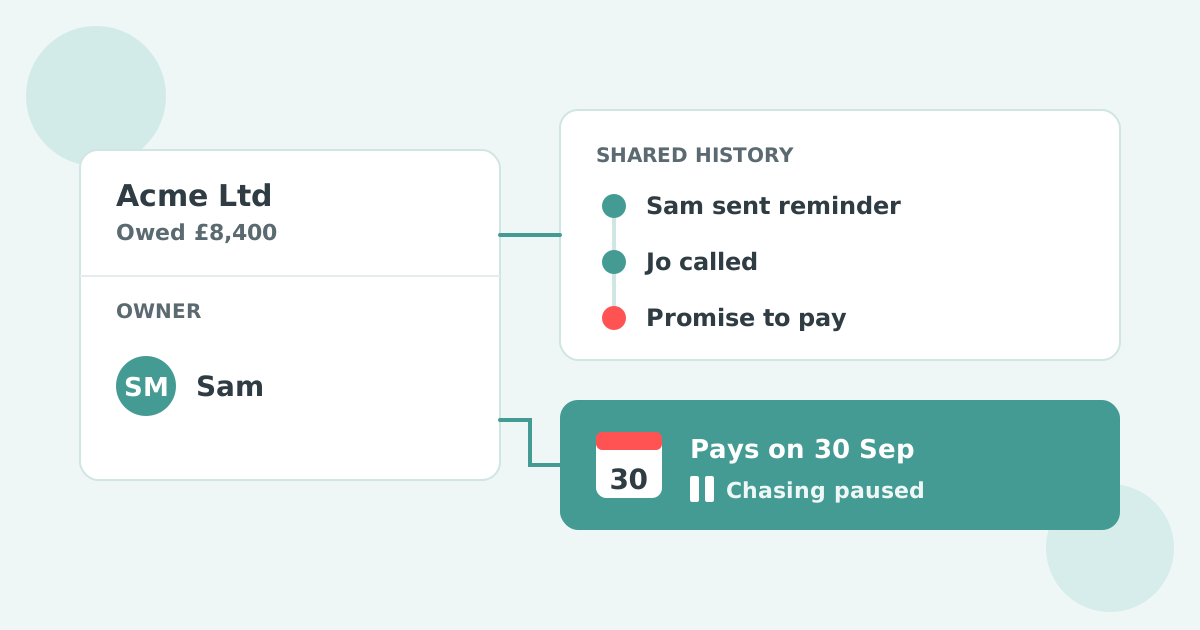

When a finance team shares the chasing, pick credit control software on four team needs: a named owner per customer, a send history by user, a payment date that pauses chasing, and an approval step before anything goes out.
Credit control software automates the work of getting invoices paid. The core is automated chasing on a schedule, a customer payment portal, cash application that matches payments to invoices, credit risk checks before you extend terms, and a sync with the accounting system (Xero, QuickBooks, Sage or NetSuite). Reporting tracks days sales outstanding (DSO), the average number of days customers take to pay.
A finance team needs a second layer on top of that core. Each customer has one owner. Every email and note sits in one shared history. Sends can wait for approval. When a customer promises a date, the chasing stops until that date. Price matters here too, because some tools charge per user.
This guide covers the team side of the decision. For turnover gates and plan eligibility across the same four tools, see credit control software compared by turnover, seats and cost. For monthly prices, see credit control software pricing.
Xero and QuickBooks Online let a team log in to one ledger, but neither gives a customer an owner or a clear record of who chased it and when.
Xero. Xero prices each plan per organisation, so a colleague does not add a subscription fee. Invoice history records the first send and resends, but resent reminders do not show clearly in that history (Xero product ideas). Invoice reminders are set once for the whole organisation, and customer replies go to the user who switched reminders on. Xero documents no owner field for a contact or invoice.
QuickBooks Online. The QuickBooks pricing page sets a user limit per plan: Simple Start 1 user, Essentials 3, Plus 5 and Advanced 25, each with 2 or 3 extra accountant seats. Custom user roles come only with Advanced. QuickBooks documents no owner for a customer.
Here is how a shared ledger behaves today when two people chase from it:
For a step-by-step fix inside Xero alone, read how to track overdue invoices in Xero as a team.
Give each customer account one owner and split the work by chase stage: routine reminders, direct follow-up, escalation and the relationship call.
The Chartered Institute of Credit Management says a credit function can range from a single experienced credit manager to teams of over 50 credit controllers (CICM).
Four roles tend to share the work. They are often combined in one person in a smaller business:
| Chase stage | Who does it | What the team needs to see |
|---|---|---|
| Before due and just overdue | Automated reminders, checked by the AR clerk | What went out and to which contact |
| Overdue, no reply | Credit controller or customer owner | Every earlier email and any reply |
| Promise to pay given | Customer owner records the date | The date, and that chasing has paused |
| Promise broken or dispute | Finance manager, with the account manager | Notes, the owner and the full history |
| Final demand or collections | Finance manager or FD approves | The approval, before anything is sent |
One person owns each customer. Anyone can see that person's history, and holiday cover means reassigning the customer to a colleague. If the business has no credit controller at all, credit control without a credit controller covers that set-up.
Paidnice documents a customer owner and Upflow documents account-manager assignment. Chaser and Paidnice document a shared history. Kolleno charges per user, and the other three do not.
| Team requirement | Chaser | Kolleno | Upflow | Paidnice |
|---|---|---|---|---|
| Owner per customer | Not published | Not published | Account manager | Customer owner |
| Send history by user | Shared log, notes | Not published | Not published | Every email, by user |
| Payment date pauses chasing | Not published | Not published | Promises detected | Pauses, then resumes |
| Replies visible in the tool | In customer log | Collections inbox | Not published | Yes |
| Approval before sends | Not published | AI drafts for review | Not published | Every action |
| Per-seat cost | 4 users, then £10 | $650 per user | Unlimited seats | None |
| Customer status view | Customer insights | Not published | Custom dashboards | Contact summary cards |
| DSO or payment trends | DSO reporting | DSO reporting | Countback DSO | DSO, trends, 1-100 score |
| Customer payment portal | Yes | Yes | Yes | Yes |
| Ledgers | Xero, QBO, Sage, NetSuite | Xero, QBO, NetSuite, SAP | Xero, QBO, NetSuite, Sage | Xero, QBO |
Yes The vendor documents the capability.
Partial It exists with a limit: a plan cap, a review step on AI drafts only, or detection without a documented pause.
No The vendor's own documentation shows it is absent, or charges for it.
Not published The vendor documents nothing either way, so treat it as unknown.
Prices as at September 2026. Chaser's 4-user limit and £10 extra user apply to its Compact plan; its Core and Complete plans include unlimited users. Kolleno connects NetSuite and SAP on its Enterprise plan.
Chaser suits UK firms that want every chasing channel, priced by annual revenue from £199 a month, Kolleno suits ERP teams that match bank files, and Upflow suits teams that manage by analytics.
Chaser
Fits: UK firms priced by annual revenue, from £199 a month up to £4m and on larger plans above it.
Entry cost: from £199 a month ex-VAT on Compact, up to £4m revenue. User terms are in the matrix above.
The one thing it does best: collections reach. Email, SMS, posted letters, automated text-to-speech calls, credit checks, a partner collection agency route and its own debtor chasing service.
The honest limitation: every user has full access to every feature and setting, and Chaser documents no owner field on a customer or invoice.
Kolleno
Fits: businesses above $1m turnover, most of all teams on NetSuite or SAP.
Entry cost: priced per user on BusinessPay. The figure is in the matrix above.
The one thing it does best: cash application. It reads bank files and parses remittance emails to match payments.
The honest limitation: Kolleno documents no named owner per customer. It gives Admin, Member and Viewer roles.
Upflow
Fits: recurring-revenue businesses that run collections by DSO and dashboards.
Entry cost: from $440 a month on GrowiUpflow's last published price. Upflow now quotes by gross invoice value.
The one thing it does best: analytics. Countback DSO, ageing and collection rate, filtered by workflow, country or custom field.
The honest limitation: no current public price, and no payment plans. Late fees run only through an ERP such as NetSuite.
Chaser and Kolleno do things Paidnice does not, such as credit checks and, for Kolleno, bank-file matching. Choose on the job your team needs most.
Paidnice assigns customers to owners, logs every email with the user who sent it, pauses chasing on a promised date and puts every action through approval.
Paidnice runs reminders and statements on a Xero or QuickBooks Online ledger, then adds the team layer on top. Late fees and interest are optional per customer group, so a team can turn them on for some customers and leave them off for others.
Plans start at $69 / £49 a month on Essentials with 2 users, and Pro starts at $99 / £74 a month. Paidnice prices by invoice volume, so the price follows the work Paidnice does, whatever the size of your business. The first 20 actions are free, with no card and no time limit.
Proof: 5.0 from 83 reviews on the Xero App Store, and $1 billion collected on time across more than 1 million invoices since 2022.
Paidnice insightA promised payment date only helps a team if the software acts on it. In Paidnice the date pauses collection on that invoice or contact, so the colleague who did not take the call cannot chase a customer who has already agreed to pay.
See how it works on the Paidnice credit control software page.
Short answers on who owns credit control, the tools a credit controller uses, splitting customers, using a credit controller, chasing inside Xero or QuickBooks and seat costs.
Who is responsible for credit control in a business?
In a small business it is usually the finance manager or a bookkeeper, with the FD holding the overdue total. In larger teams a credit controller runs it and reports to the financial controller or finance manager. Whatever the size, each customer account should have one named owner.
What tools does a credit controller use?
The accounting system for the ledger, then credit control software for scheduled reminders, statements, escalations and a shared history. Some tools add credit checks, a customer payment portal, payment plans or bank-file matching. A shared inbox or a team chat channel often handles alerts.
Can each customer be given to a different person on the team?
Yes, if the tool supports an owner per customer. Paidnice lets you assign a customer an owner. Xero and QuickBooks Online document no owner field, so the split has to be tracked outside the ledger.
Is software still worth it when a credit controller is on staff?
Software takes the routine reminders and statements off the credit controller, so their time goes to calls, disputes and promises. It also keeps a history that the rest of the team can read, which matters most when the credit controller is on leave.
How is this different from chasing inside Xero or QuickBooks Online?
Xero sets invoice reminders once for the whole organisation, sends replies to the user who switched reminders on, and documents no owner field. QuickBooks Online limits users by plan and documents no owner for a customer. Credit control software adds a customer owner, a shared send history, a pause on a promised date and approval before sends.
Does adding people to credit control software cost more?
It depends on the vendor. The per-seat cost row in the matrix above sets out each tool's user terms.
Paidnice is accounts receivable automation that enforces your payment terms, trusted by thousands of businesses on Xero and QuickBooks. Credit control and debtor management, run for you.
Try it Now - It's FreeNo card required.




Optimize your cash flow with our suite of financial tools designed for AR professionals. Calculate DSO, aging analysis, late fees, and more.