
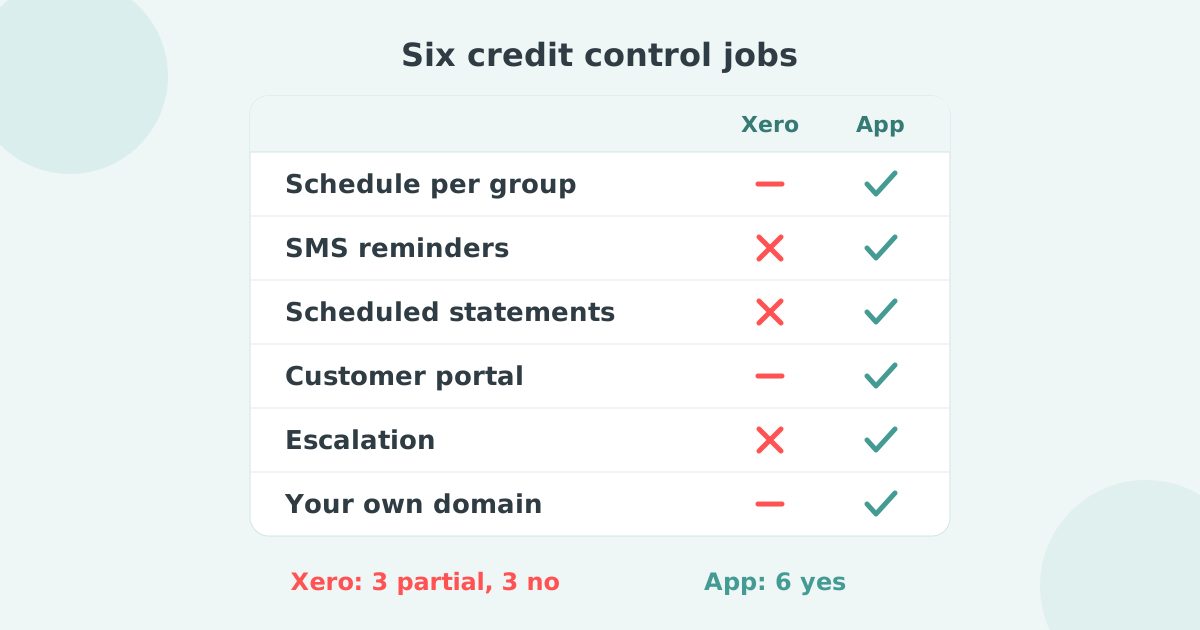

A credit control app does twelve jobs on your Xero invoices. Xero's native reminders do part of four of them and none in full, and the trigger to move is the second customer group. For the ranked list of tools, see credit control software for Xero.
The eleven jobs Xero does not run are per-group schedules, SMS, scheduled statements, late fees, interest, payment plans, a customer portal, escalation to a person, sending from your own domain, quote reminders, and receivables reporting. The table in the second section sets each one beside what Xero does natively.
Xero invoice reminders are up to five automated emails per organisation, each fired a set number of days before or after the due date, with three enabled by default. There is no SMS, no contact-group targeting, and no scheduled statement.
Here is the full list of what the native feature does, taken from Xero's own setup articles (How invoice reminders work and Set up invoice reminders). The full walk-through is in Xero invoice reminders: how they work, and where they stop.
Xero's product ideas board shows which of those gaps are on the roadmap and which are not, and three matter here. Interest on late invoices has 1,112 votes, was posted on 29 March 2012, and Xero's latest reply (7 July 2025) calls it "early days" with no committed plans (source).
SMS reminders have 76 votes and a 17 June 2026 reply that says reminders by SMS are "not in our current roadmap" (source). Auto-emailed statements have 1,169 votes and sit "In discovery" as of 5 August 2026 (source).
A dedicated credit control app connects to Xero, reads the same invoices and contacts, and runs twelve jobs on them. Xero's native reminders cover four of the twelve in part and none in full. The table shows each job side by side.
| Job | Xero native reminders | Dedicated credit control app |
|---|---|---|
| 1. Reminder schedule per customer group | Partial One schedule per organisation, up to five emails. On or off per contact or invoice only. | Yes Separate schedules, tone, and timing per group: key accounts, slow payers, new customers, one-off jobs. |
| 2. SMS reminders | No Xero can send the invoice by SMS in AU, NZ, UK, and US, but reminders are email only. "Not in our current roadmap", 17 June 2026. | Yes SMS as a step in the schedule, usually charged per message. |
| 3. Scheduled customer statements | No Statements are sent by hand from the contact. Auto-email idea "In discovery", 1,169 votes. | Yes Monthly or weekly statements on a schedule, with consolidated parent and child statements in some apps. |
| 4. Late fee per overdue invoice | No A manual invoice raised by hand, if at all. | Varies Some apps raise a fee invoice on the ledger automatically; some do not offer late fees at all. |
| 5. Interest on the overdue balance | No 1,112 votes since 29 March 2012, "early days" as at 7 July 2025. | Varies Statement interest at a rate per annum, prorated daily, on the apps that offer it. UK statutory rate is 8% plus Bank of England base rate. |
| 6. Payment plans on a single balance | No | Varies Instalments and auto-pay through a connected payment provider on some apps. |
| 7. Customer payment portal | Partial Online invoice link, with a pay-now button where a payment service is connected to Xero. No account-level view of every open invoice. | Yes One page per customer showing every open invoice, statement, and payment option. |
| 8. Escalation to a named person | No Nothing happens after the fifth email. | Yes At N days overdue or above a balance: phone-call task, stop-credit, legal letter, assigned to a person and logged. |
| 9. Sending from your own domain | Partial Reminders send from Xero's own system address. The reply-to address is configurable per organisation, so replies reach your inbox, but the sender domain stays Xero's. | Yes Domain authentication or a mailbox connection so the reminder arrives from accounts@yourcompany. |
| 10. Quote and estimate reminders | No Reminders fire on invoices only. | Varies Follow-ups on unaccepted quotes on some apps. |
| 11. Multi-entity view | No One organisation at a time. | Varies One login across several Xero organisations, often as a per-entity add-on. |
| 12. Receivables reporting | Partial Aged Receivables report. No DSO, on-time rate, delivery status, or slowest-payer view. | Yes DSO, days sales overdue, on-time percentage, email delivery health, per-customer payment history. |
| Tally, 12 jobs | 4 partial8 no None in full | 7 yes5 vary by app Rows 4 and 5 split the category |
Rows 4 and 5 split the category in two, so check them before choosing an app. Chaser and Paidnice apply fees or interest; Satago's late-fee mechanics were not verified for this page; no late-fee capability was found for Kolleno or Upflow as at September 2026 (verify current features). If a fee policy is part of your terms, the apps without one drop out of the list early.
The row that decides it for most Xero users is row 1, the schedule per customer group. Once one group should get a polite reminder at seven days and another should get a fee at fourteen, a single organisation-wide sequence cannot serve both. Every other row follows from that split: different groups need different fee policies, different senders, and different escalation paths.
The trigger is the second customer group. Xero's single schedule works while every customer can be treated the same way. It stops working the day one group needs a different schedule, fee, or tone from the rest.
The finance desk: "We turned reminders off for our biggest customer because the tone was wrong for them, and now nobody chases them at all."
The owner: "The same six names are on the overdue list every month and the emails are not moving them."
The bookkeeper: "I send statements by hand on the first of the month and it takes a morning."
The sales lead: "Our terms say 8% plus base rate on late invoices and we have never once charged it."
Each quote maps to a row Xero does not run: rows 1, 8, 3, then 4 and 5. Two numbers put a cost on the trigger. Xero's own Small Business Insights for the June 2026 quarter show UK small businesses waiting 29.3 days on average to be paid, 8.3 days past terms (Xero SBI).
Atradius's 2026 UK survey found roughly 68% of B2B sales are made on credit and late payment affects about 25% of invoiced B2B turnover (Atradius, 3 June 2026). A reminder feature that treats all of that turnover identically is doing one job on a problem that needs twelve.
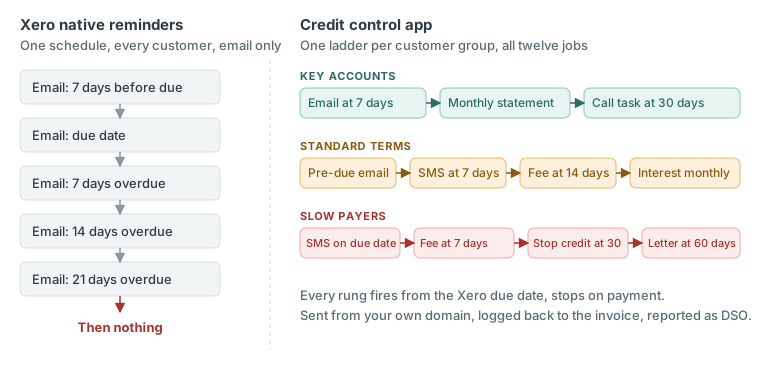
Once an app runs the process, each customer group gets its own ladder: pre-due reminder, due-date reminder, overdue reminder, SMS, statement, late fee or interest, then escalation to a person, each rung fired from the Xero due date.
Templates for steps 2 and 5 are in email templates for invoice payment reminders and letter before action template. The UK fee figures for step 4 are in late payment fees in the UK: 8% plus the Bank of England base rate under the 1998 Act, and fixed sums of £40, £70, or £100 by invoice size.
The fee exists so that the invoice with a fee on it gets paid before the invoice without one. Put the policy in your terms, apply it consistently across a group, and be willing to waive it on the phone in exchange for payment today. A fee that is applied and then negotiated away still did its job.
The right app depends on which rows you need. Chaser suits larger businesses that want credit checks. Satago pairs reminders with invoice finance. Paidnice runs fees, interest, statements, and plans in one plan. Kolleno leads on cash application. EzyCollect is the Australian option.
| App | Leads on | Late fees or interest | Xero App Store, September 2026 | Entry price, as at September 2026 |
|---|---|---|---|---|
| Chaser | Established tool for larger businesses: email, SMS, and credit checks; Compact tier up to £4M revenue | Yes | 4.98 from 374 reviews | £199 a month |
| Satago | Automated reminders plus invoice finance | Not verified | 4.93 from 92 reviews | See vendor pricing |
| Paidnice | Fees, statement interest, statements, plans, and escalation in one plan; two team members on Essentials, unlimited on Pro | Yes, both per-invoice fee and statement interest | 5.0 from 83 reviews | £49 a month |
| Kolleno | Cash application and analytics for larger finance teams | No late-fee capability found | 5.0 from 18 reviews | €650 per user a month |
| EzyCollect | Australian debtor management, listed on the AU Xero App Store | Not verified | 4.94 from 35 reviews (AU store) | See vendor pricing |
Prices are as at September 2026; verify current pricing before you buy. The six-tool ranking with fit-by-situation lives at credit control software for Xero: 6 tools compared. This page is the native-versus-app decision; that one is the app-versus-app decision.
We built Paidnice around rows 4 and 5 first, because the interest idea on Xero's board has sat open since 29 March 2012 and the fee is the rung that changes payment behaviour. On our side, both charge types run on one customer group at once, and the interest figure the customer opens is the figure as of that morning.
Measure the switch with days sales outstanding (DSO) before and 30 days after. DSO can be worked out from Xero's Aged Receivables report and your sales figure, and most credit control apps show it on the dashboard, so it is a fair comparison.
The formula and a worked example are in DSO calculation formula. Read the result three ways:
The five questions below are the ones readers ask about this decision, starting with the one Google shows against this search. Short answers, with the row of the table each one maps to.
Can you send invoice reminders on Xero? Yes. Sales, Invoice settings, Invoice reminders. Up to five per organisation, three on by default, timed in days before or after the due date, email only. Row 1.
Does Xero send SMS payment reminders? No. Xero can send the invoice itself by SMS in the UK, AU, NZ, and US, but reminders are email only, and Xero said on 17 June 2026 that SMS reminders are not on the current roadmap. Row 2. See SMS payment reminders for Xero.
Can Xero add interest or a late fee to an overdue invoice? Not automatically. You can raise a manual invoice for the fee. The automatic version has been an open product idea since 29 March 2012 with 1,112 votes. Rows 4 and 5. See how to add late payment fees in Xero.
Can Xero email statements automatically? No. Statements are sent by hand from the contact. The auto-email idea has 1,169 votes and is in discovery as at 5 August 2026. Row 3. See automatic customer statements for Xero.
Can I set different reminders for different customers in Xero? Only by turning reminders off for a contact or an invoice. There is no second schedule. Row 1. See different Xero invoice reminders for different customers.
Paidnice is accounts receivable automation that enforces your payment terms, trusted by thousands of businesses on Xero and QuickBooks. Credit control and debtor management, run for you.
Try it Now - It's FreeNo card required.

Optimize your cash flow with our suite of financial tools designed for AR professionals. Calculate DSO, aging analysis, late fees, and more.