


Summary
The Paidnice MCP server connects Claude, ChatGPT and other AI agents to Paidnice, so a Xero business or practice can work its receivables from the chat. One connection covers every organisation the user selects, and anything sent to a customer waits for a person to approve it.
- What it does: Reads customer email and SMS replies, contacts and invoices, keeps contact people current in Xero, and answers questions such as who owes the most.
Xero holds the ledger. Paidnice holds what happens after the invoice goes out. Now Claude and ChatGPT can read both.
Ask Claude who owes you money, and what they said about it
Paidnice, the accounts receivable automation app, and now credit control AI for Xero, has released an MCP server that lets Claude and ChatGPT run credit control from the chat. A finance team or practice can ask who owes the most, read every customer reply, approve the day's reminders, log promises to pay and forecast the week's cash, without opening another screen.
MCP (Model Context Protocol) is a way to plug an AI assistant such as Claude or ChatGPT into the apps a business already uses. One Paidnice connection covers every organisation the user picks, so an accountant can ask about any client by name. Some of the newest tools are open through the Paidnice beta programme, and businesses and practices can apply at paidnice.com/mcp.
The 1 customer in 20 problem
Paidnice's own analysis of 6.9 million invoices from 2,700 businesses shows where overdue money comes from. Two customers in three never go seriously overdue. The worst 1 in 20 bill 24% of revenue and cause 70% of the seriously overdue money.
1 customer in 20 causes 70% of seriously overdue money
Picture 20 customers. The worst one also bills 24% of revenue.
Source: Paidnice analysis of 6.9 million invoices from 2,700 businesses. Median across 1,670 businesses with 50 or more customers.
The warning signs come early. After an on-time payment, a customer's next invoice is paid on time 84% of the time. After one payment just 1 to 7 days late, that falls to 29%.
And the window is short. A UK invoice 7 days overdue has a 21% chance of still being unpaid at 180 days. At 30 days overdue, that rises to 41%. The figures are 20% and 43% in Australia, and 14% and 31% in New Zealand.
The risk roughly doubles by day 30
Chance an invoice is still unpaid 180 days after its due date
Source: Paidnice analysis of invoices due up to 31 March 2026, followed to 180 days after the due date.
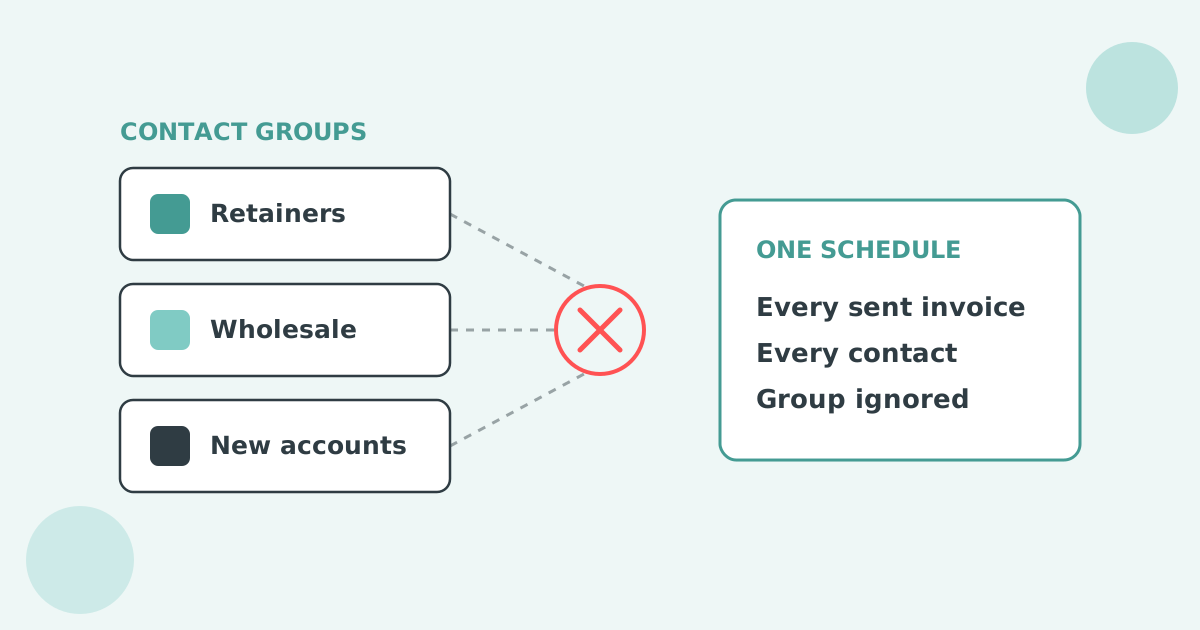
A single reminder schedule treats every customer the same. Finding the few who matter means reading replies and payment history every day, which is hard to keep up by hand. That daily reading is the work the Paidnice MCP server hands to AI.
Find the customers who will cost you, before they do
- Ask about the whole ledger. "Who owes us the most, and for how long?" returns the biggest and oldest balances without a report.
- Triage replies by balance. The assistant sorts overnight replies into promises, questions and disputes, then ranks them by what each customer owes.
- Forecast this week's cash. See what should land from each customer's payment habits, and which invoices are at risk.
- Check "we already paid". With a Xero connector in the same chat, the assistant checks for the payment or an unreconciled deposit.
Move in the first week, when it counts
- Clear the approval queue in one message. "Approve today's drafts under £2,000. Hold the rest."
- Send reminders and statements from the chat, each one approved before it goes.
- Log calls, promises and disputes in a sentence, so reminders wait while a promise or query is open.
- Offer payment plans and work escalations from the chat, with the context for each customer.
- Build policies by asking. Describe a tighter schedule for customers who have paid late before, and the assistant drafts the policy for review.
Every client, one conversation
For bookkeepers and accountants, one connection reaches every client organisation they manage. They can ask which client has the most overdue this month, pull a month-end pack with days to get paid, overdue and collected for each client, and turn a week of customer replies into a short update for the client.
A person approves every send
Paidnice's AI already reads each customer reply and prepares the next step under the business's own credit policy, for a person to approve. The MCP server keeps that rule: anything sent to a customer from the chat waits for approval. The connection uses a Paidnice sign-in with no API key. The user picks the organisations and chooses Read, or Read and Write. Every request is logged in Paidnice, and a connection can be revoked at any time.
"Claude can now read the replies and the Xero balance in one chat, so you see who to deal with first. A few customers cause most of the overdue money, and the first week late is when it counts. It reads replies and keeps contacts current for every customer today, and sending and approvals are open through our beta programme, with a person approving every one."
Denym Bird, Co-founder and CEO, Paidnice
How to connect it
The Paidnice MCP server works with Claude, ChatGPT, Claude Code and any agent that accepts a remote MCP server as a custom connector. The beta tools listed above are open to approved beta users, and businesses and practices can apply at paidnice.com/mcp. Users also need a Claude or ChatGPT plan that allows custom connectors, and a Xero connector in the same chat to see Xero balances and payments.
To start, add https://api.paidnice.com/mcp as a connector in Claude or ChatGPT, sign in to Paidnice, tick the organisations, and ask "who owes us the most?".
See every tool and apply for the beta, or book a demo to see it running on your own Xero data.
About the data
Paidnice analysed 6.9 million invoices from 2,700 businesses in the UK, Australia, New Zealand, the US and Canada, due 1 January 2025 to 31 July 2026. "Seriously overdue" means unpaid 75 days after the due date, or paid more than 30 days late, and the customer figures are the median across 1,670 businesses with 50 or more customers. The repeat-payment figures measure each invoice 75 days after its due date. The overdue figures follow invoices due up to 31 March 2026 to 180 days after their due date. Each figure holds in three separate time periods and with the five largest businesses removed. The figures describe payment behaviour across the sample; they do not measure the effect of Paidnice.
Paidnice is accounts receivable automation for small and mid-sized businesses on Xero: automated reminders, statements, late fees and interest, payment plans, escalation and a customer payment portal, run for you. Businesses using Paidnice have collected $1 billion on time across more than 1 million invoices since 2022. Paidnice was named New Zealand Small Business App of the Year at the Xero Global App Awards 2026, and Global Small Business App of the Year in 2025.

 App of the Year