

Summary
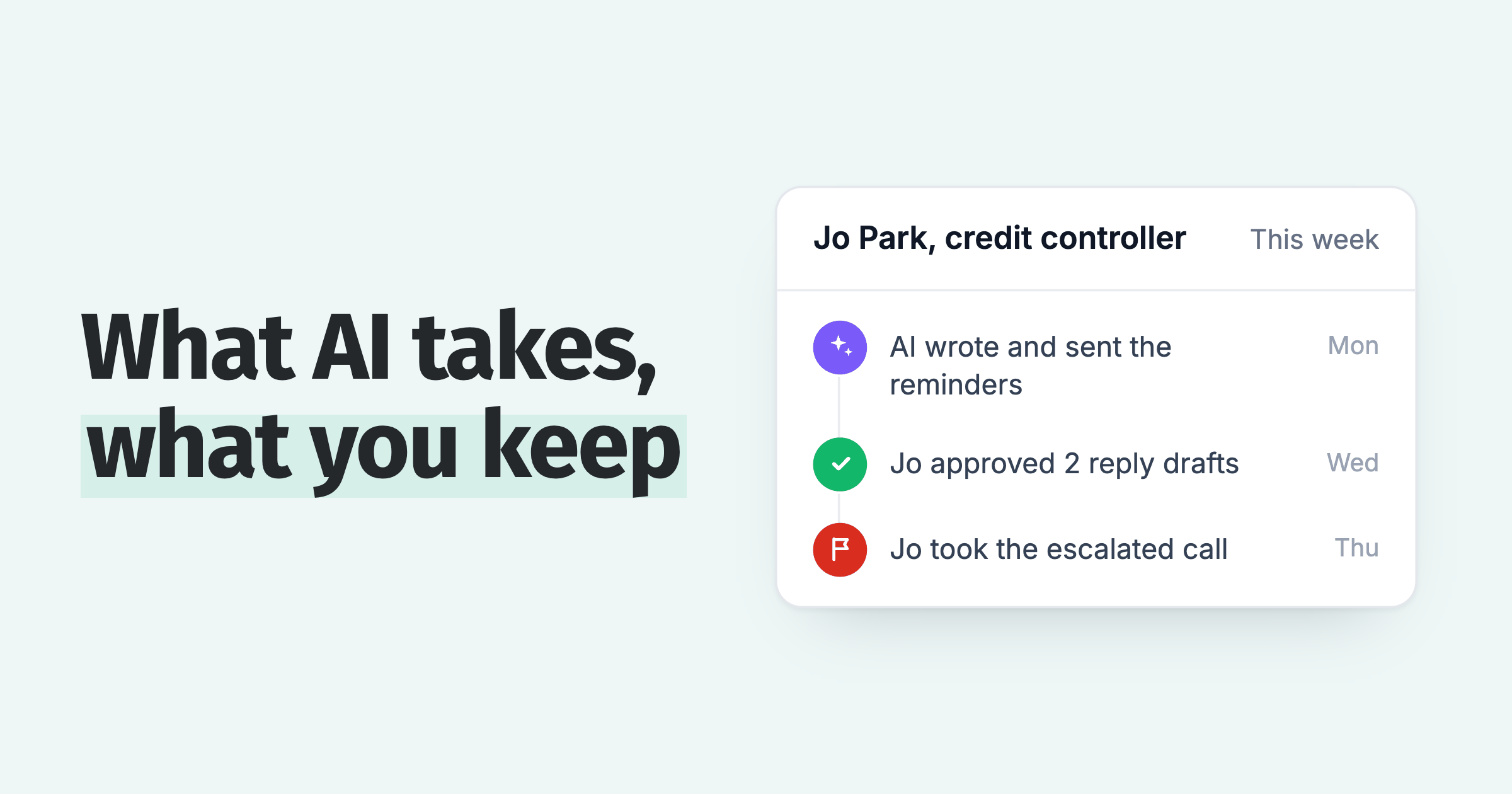
No, AI will not replace credit controllers. It takes over the routine writing and reading: reminders, reading replies and logging promised payment dates. A person approves each reply unless that type is pre-approved, talks to customers in difficulty and decides credit stops, terms and legal action.
- What AI takes: AI writes each reminder, reads replies for the payment date or PO number, and logs promised dates against the invoice.
- What a person keeps: Calls to a customer in financial difficulty, stops on credit, new terms and legal action stay with a person.
- In Paidnice: An escalated case reaches a person with the customer's credit score, average days to pay and email history attached.
It is Monday and the overdue list is open. UK small businesses waited an average of 29.1 days to be paid in the June 2026 quarter, so the list refills as you clear it. By Wednesday the replies are in: a payment date, a PO number request, a claim that the invoice is wrong. Here is which parts of that work AI takes, and which stay with you.
Will AI replace credit controllers?
AI will not replace credit controllers: it takes the routine writing and reading, and the role shifts toward decisions, conversations and approvals.
The routine part does shrink. A 2026 NBER working paper based on a survey of nearly 750 US financial executives expects AI to cut aggregate employment by less than 0.4% in 2026, and finds office and administrative support roles the most exposed. Typing reminders, reading replies and logging payment dates is that kind of work.
The rest of the job is judgement: whether to extend credit, what to agree with a customer who cannot pay this month, when to stop supply, when to involve a solicitor. Those decisions stay with a person.
For the approval steps themselves, see how AI credit control works in Paidnice.
Which parts of a credit controller's job can AI do?
AI can do the writing and reading in a credit controller's day, and a person keeps every duty that decides credit, terms or legal action.
The duties below follow the National Careers Service credit controller profile. The two right-hand columns show how each duty splits when Paidnice does the writing and reading.
| Duty | Paidnice does | A person does |
|---|---|---|
| Chase overdue invoices | Writes each reminder from the customer's open invoices, recent payments and any late fee coming | Approves the draft, or lets reminders send on schedule |
| Check credit and set up credit accounts | Scores each customer 0 to 100 on late payments and overdue balance | Sets the credit limit and the terms, and decides whether to extend credit |
| Speak to customers to arrange repayment | Reads the reply, drafts the answer and proposes a payment plan, new terms or a stop on credit | Talks to the customer, agrees the plan and decides the terms |
| Start legal action on unpaid debts | Raises an escalation when your rule is met, with the history attached | Decides on a letter, a solicitor or legal action |
| Process payments and keep customer records up to date | Logs promised dates and PO numbers on the invoice, and syncs payments back to Xero or QuickBooks | Checks anything unusual and follows up a broken promise |
| Produce credit reports for management | Builds the aged receivables report and emails a saved view as a CSV weekly or monthly | Reads the report and decides what to do about it |
What does a credit controller's week look like when AI writes the first draft?
A credit controller's week shifts from typing reminders and logging replies to approving drafts, taking calls and working the accounts that need judgement.
- Monday. Reminders go out from your policies. Where a template is set to AI, each one is written from that customer's open invoices and recent payments. An Active policy sends on schedule; a Draft policy holds each one until you approve it. Either is a normal way to run.
- Midweek. Replies arrive. Paidnice reads each one for the payment date or PO number and drafts the answer. You approve it, change it, or have already pre-approved that type of reply.
- Friday. The hours that went on typing go on calls, payment plans and escalations instead.
Paidnice reads the reply, logs the promised date against the invoice and drafts the response. Policies set to "Skip when payment promised" then wait until that date before they send anything else to the customer.
To see the drafts before anything reaches a customer, start in Safe Mode: Paidnice prepares actions for review but does not send anything to customers. See also what to do with each kind of reply and what AI handles across receivables. For the platform view, see Xero JAX and overdue invoices and the QuickBooks AI agent on overdue invoices.
What stays with a person, and why?
A person keeps the decisions that change money, terms or the relationship: a customer in difficulty, a stop on credit, special terms, whether to claim interest, and any legal step.
- A customer in financial difficulty. AI can propose a payment plan. Agreeing one the customer can keep takes a conversation between two people.
- A stop on credit. Pausing supply changes the relationship, and sometimes the customer's own business, so a person weighs it.
- Special terms. A longer term for a good customer in a bad quarter is a commercial call.
- Interest and recovery costs. In the UK a business can claim interest and debt recovery costs when another business pays late (general information, not legal advice). Paidnice can apply statutory interest by policy. Waiving it for one customer is a person's call.
- Legal action. A formal letter or a solicitor sits on the top rungs of the escalation ladder, after the reminders, and the decision to climb that far is yours.
A dispute sits in the same group. Paidnice uses AI to find the reason and prepares the actions to resolve it, for you to approve or change. Whether to raise a credit note or hold your position is your call. How to handle a disputed invoice covers the steps.
When a case needs a person, it reaches one with the context attached. An escalation to a call, a stop on credit or a template legal letter lands with the assigned person, with the customer's credit score, average days to pay, past escalations and email history, and they choose the next step.
Does a small business still need a credit controller?
A small business still needs someone to own credit control, whether a credit controller, the finance lead or the owner, because software takes over the routine chasing and the decisions still need a person.
The same NBER paper finds that smaller US firms anticipate modest employment growth from AI, while larger firms expect cuts. For a business with one finance person on Xero or QuickBooks Online, the change is in what that person spends the week on.
If credit control is nobody's job today, how credit control runs when it is nobody's job sets out the minimum. If you would rather hand it to a specialist, outsourced credit control explains when an outside firm fits.
Questions about AI and credit controllers
Which credit control tasks will AI take over first?
Writing reminders, reading replies for payment dates and PO numbers, and logging those against the invoice. These are the reading and typing jobs, and they are the first to move.
Can AI do credit control without a person?
For the routine work, yes. An Active policy sends AI-written reminders with no approval for each send. Reply drafts wait for approval unless you pre-approve that type, and disputes, stops on credit and legal action stay with a person.
Will debt collectors be replaced by AI?
AI takes the routine messaging. Calls, negotiation and the decision to escalate stay with people. In Paidnice an escalation to a call is assigned to a person, and that person makes the call.
How much do credit controllers get paid in the UK?
The National Careers Service puts it at about £21,000 a year at the start and £32,000 with experience, depending on the employer and the location.
 App of the Year