


Summary
You can run collections across OneWorld subsidiaries by deciding how each customer is set up first. A customer shared across subsidiaries gets one statement per subsidiary on dunning, and a parent with child accounts needs Consolidated Payments. Reminders compare amounts in the invoice's own currency. Paidnice runs the subsidiaries on one connection.
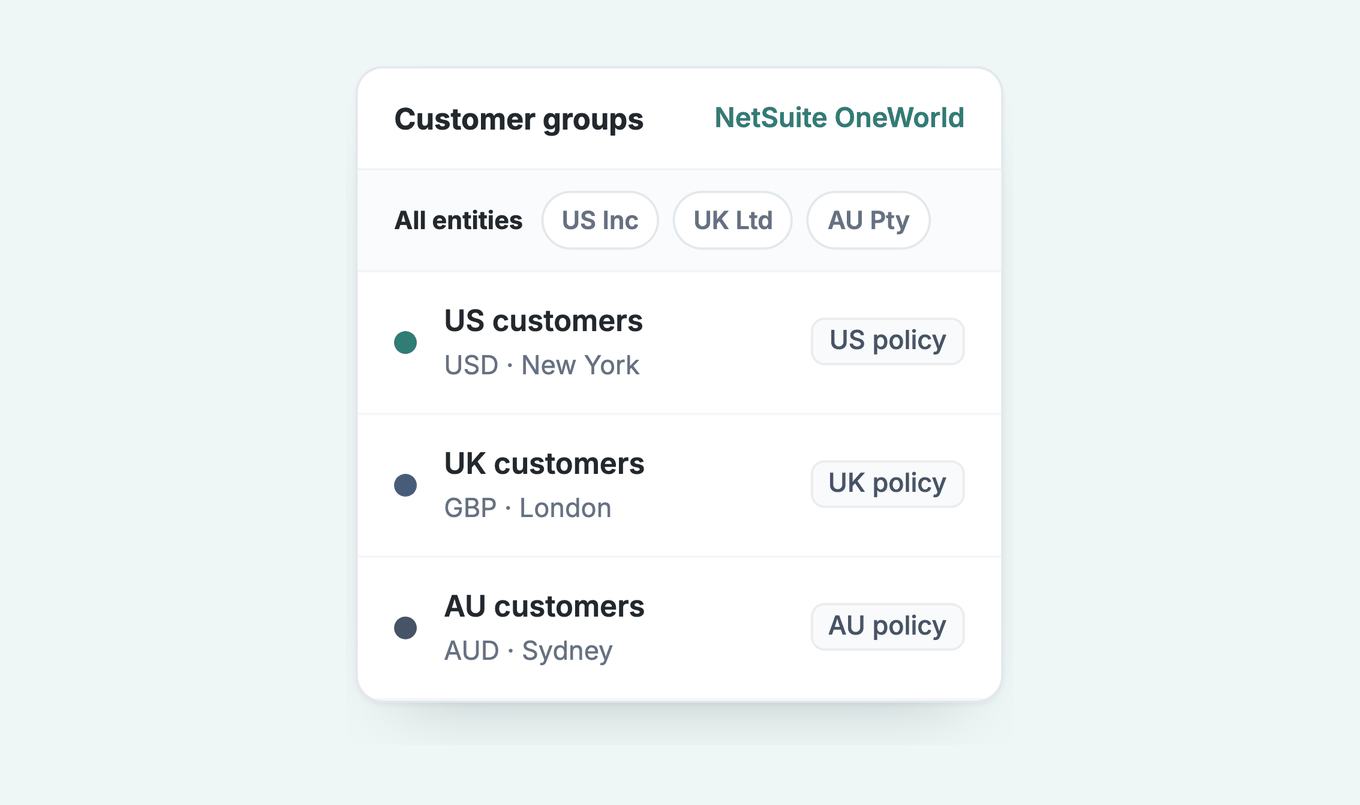
- Paidnice: One NetSuite connection for the OneWorld account; each entity chases in its own name, currency and time zone, with the team split by entity.
- Shared customers: With Multi-Subsidiary Customer on and an Advanced statement form, the dunning email attaches one statement per subsidiary.
- Parent and child: Consolidated Payments changes what a statement and a payment cover. The credit limit still leaves subcustomers out.
- Currencies: Each dunning level rule carries a currency, and finance charges accrue in the overdue invoice's currency.
Paidnice connects to your ERP on the Custom plan. Book a demo on your own data, and a specialist sets up the connection.
One customer buys from three of your subsidiaries. Oracle's dunning email sends that customer one statement per subsidiary, and the Generate Statements run that could show the whole relationship has no schedule, so someone runs it each month. Nobody is sure which subsidiary should own the customer.
This page covers what NetSuite dunning sends for each kind of OneWorld customer, what Consolidated Payments changes, which currency a reminder uses, and how Paidnice runs the subsidiaries on one connection. For UK and Australian teams, this is credit control across group companies, with debtors spread over several entities. The credit control software for NetSuite guide covers the tools.
How does NetSuite dunning work across subsidiaries?
NetSuite dunning runs on customer records, not on a group view: each procedure applies to customers, invoices or invoice groups, and automatic customer assignment is set per subsidiary.
OneWorld gives each subsidiary its own base currency inside one account, and the Dunning Letters SuiteApp will not run without the Multiple Currencies and Multi-Language features on. Multi-language letters need one template per language plus a default language.
A dunning procedure's Applies To setting is customer, invoice or invoice group, and it cannot be changed after the procedure is saved. Oracle calls customer level the recommended standard. For shared customers, customer level is also the only level that can carry a statement (see the next section).
Assign Automatically to New Records for customers and invoice groups uses a subsidiary, a saved search and a priority. A group with five subsidiaries builds its assignment rules five times. Our guide to saved searches for overdue invoices covers the search side.
One report to watch: a thread on the NetSuite Professionals archive describes dunning missing invoices from another subsidiary when the customer's primary subsidiary differed, with no confirmed fix. Test a shared customer on your own account before you rely on automatic assignment.
The queue caps are the same as for a single entity: the Dunning Email Sending Queue and the Dunning PDF Printing Queue each take 100 letters at one time. The NetSuite dunning limits post lists the rest.
Free: Payment reminder email templatesCopy the reminder emails for before, on and after the due date.What about customers that buy from several subsidiaries?
With Multi-Subsidiary Customer on and the statement form's Printing Type set to Advanced, the dunning email attaches one statement per subsidiary, each showing that subsidiary's amount due.
That is Oracle's own description in its page on attaching statements to dunning letters. The customer who buys from three subsidiaries gets one email with three statements. The page says nothing about the currency shown on each attached statement.
Statements cannot be attached when dunning runs at invoice or invoice-group level. So a shared customer needs a customer-level procedure, with Allow Letters to be Emailed ticked on the customer record and an Advanced PDF/HTML statement form.
Outside dunning, a thread on the NetSuite Professionals archive reports that the standard statement workflow covers only the customer's primary subsidiary. Treat that as a forum report and test it on your own run. Our guide to customer statements in NetSuite covers the Generate Statements page.
Two more Oracle facts matter here. A Multi-Subsidiary Customer keeps a balance per subsidiary: the Balance and Unbilled Orders fields on the Subsidiaries subtab of the customer record are that subsidiary's totals, shown in the customer's primary currency, and the Deposit Balance field holds unapplied deposits (Oracle, customer balances for assigned subsidiaries). Decide which balance each collector works.
Every OneWorld account also carries representing entities: a customer record NetSuite generates for each subsidiary for intercompany transactions, flagged Is Autogenerated Representing Entity (Oracle, representing entities). Exclude those records from any collections run before the first reminder goes out.
The decision for your team is whether the customer receives one statement per subsidiary, as NetSuite sends it, or a single view of the relationship. NetSuite's native answer is per subsidiary.
Three things to settle before any tool chases a OneWorld ledger
- Intercompany exclusion. Leave the representing-entity customers out of every run, with any other account you name.
- Per-subsidiary balances. Decide which balance each collector works on a shared customer, and in which currency.
- Consolidated aging. A group aging report in the parent currency moves with the month-end rate, so agree which rate the collections view uses.
Paidnice answers the first two at scoping; the third stays a reporting choice in NetSuite.
How do parent and child customers affect collections?
Consolidated Payments lets a parent pay for its child customers and adds a Consolidated Statement option that shows the whole hierarchy balance, but the feature has to be on first.
A child customer is linked to its parent on the customer record. On the Generate Statements page, tick Consolidated Statement for the customer and subcustomer hierarchy balance, or clear it for each customer's own balance. Oracle's page on generating statements says the option needs Consolidated Payments.
With the feature on, the mini statement printed on an invoice shows the customer's consolidated balance. Oracle places the switch at Setup > Company > Setup Tasks > Enable Features, on the Accounting subtab (Oracle, Consolidated Payments).
The same page says the feature lets you accept payment for subcustomer invoices from the top-level customer or from the subcustomer. Oracle's customer deposits page adds that, with the feature on, deposits made by a customer or its subcustomers can be applied to any open invoice in the hierarchy.
The credit limit does not follow the hierarchy. Oracle states that a customer's credit limit does not include subcustomers, so a parent can reach its limit while its subcustomers keep trading. Set a limit on each child that matters.
One reported conflict: a thread on the NetSuite Professionals archive, quoting a OneWorld guide, says Consolidated Payments and Multi-Subsidiary Customers do not work together. The quoted alert reads "a subcustomer can have only subsidiaries from the pool of its parent customer's subsidiaries".
Oracle's Multi-Subsidiary Customer limitations page lists one incompatible feature, EU One Stop Shop, and does not name Consolidated Payments, so treat the conflict as a forum report and test both features in a sandbox before you rely on them.
Consolidated statements have no schedule of their own. The Generate Statements run is manual, so a monthly parent statement is a person's job each month.
How do currencies show on reminders and statements?
Every OneWorld subsidiary keeps its books in its own base currency. Bill a customer in a different currency and the transaction carries both amounts. Each dunning level rule carries a currency, a minimum amount and an overdue balance per currency.
Oracle's page on subsidiaries and currencies sets the base currency per subsidiary. A Dunning Level Rule has a Currency, a Minimum Transaction Amount and a Total Overdue Balance for each currency row. If an invoice's currency is missing from the rule, NetSuite converts the default-currency amount at the rate on the last day of the previous month and compares that.
Finance charges accrue in the overdue transaction's currency. On the Assess Finance Charges page a customer appears once per currency, and a customer can be assessed only one time per day, even if later charges are in a different currency.
A consultancy reports that subsidiary-specific finance charge rules are not native and need scripting. Our post on NetSuite finance charges covers rates and compounding.
The exchange rate shown on a dunning letter or an attached statement is not documented on Oracle's pages. Statements use either the Standard or the Standard Multi-currency template, depending on when your account began.
A receivables report run in a consolidated subsidiary context shows the parent's base currency at the Consolidated Exchange Rate, and Oracle says those amounts often differ from subsidiary-level reports (Oracle, consolidated reporting; consolidated exchange rates on reports). The balance Paidnice chases stays in the transaction currency, so give collectors that total, not the consolidated one.
What does NetSuite send, and what should you set?
NetSuite dunning sends a different thing for each of five customer setups: one letter for a single-subsidiary customer, one statement per subsidiary for a shared customer, per-customer letters plus a manual Consolidated Statement for a parent, per-currency rule rows for a non-base-currency customer, and one Default Dunning Manager per procedure.
Each row gives the settings behind it and the source. The forum-reported pill marks a NetSuite Professionals thread, not an Oracle page.
| Your customer setup | What NetSuite dunning sends | What to set | Source |
|---|---|---|---|
| One customer, one subsidiary, base currency | One letter listing all overdue invoices | Customer-level procedure; Allow Letters to be Emailed on the customer | Oracle dunning pages |
| One customer buying from several subsidiaries | One statement per subsidiary attached to the email, each with that subsidiary's amount due | Multi-Subsidiary Customer on; statement form Printing Type = Advanced; customer-level procedure (no statement at invoice or group level) | Oracle, attaching statements to dunning letters |
| Parent with child customers | Per-customer letters; a Consolidated Statement from Generate Statements shows the hierarchy balance | Consolidated Payments on; tick Consolidated Statement when generating. Conflict with Multi-Subsidiary Customer: forum-reported | Oracle, generating statements |
| Customer billed in a non-base currency | Level rules compare amounts per currency; a missing currency converts at the prior month-end rate | Add a row per currency to each level rule; pick the Multi-currency statement template | Oracle dunning level rules |
| Group with a different team per subsidiary | Letters from the procedure's single Default Dunning Manager | A procedure per subsidiary; assign by subsidiary plus saved search | Oracle dunning procedures |
The usual split is local teams owning invoices and disputes and a central team ranking risk. In NetSuite that maps to one procedure per subsidiary, each with its own Default Dunning Manager as the sender.
Sources: Oracle, dunning procedures, attaching statements to dunning letters, generating statements, dunning level rules, credit limits.
With Paidnice, the same rows read: a policy per entity; each entity chasing in its own name; each invoice chased in its own currency, with statement sections per currency; and a team limited to the entities it works. The parent and child row stays in NetSuite as above.
How does Paidnice chase in each entity's own name?
Paidnice runs OneWorld subsidiaries on one NetSuite connection, and each entity chases in its own name, currency and time zone.
NetSuite OneWorld is supported on the Custom plan with a two-way sync. Custom fields sync too, and Paidnice can replace the Dunning Letters SuiteApp. For a group, that means:
- Each entity in its own name. The reminder comes from the subsidiary that raised the invoice, sent from your own domain. One login covers every entity.
- Each invoice in its own currency. Reminders, statements with one section per currency, and fixed late fees in the invoice currency.
- Send hour per region. Each region group sets its own send hour, so a UK entity and a US entity each send at their own local hour. NetSuite's scheduled dunning workflow runs on one clock: Oracle saves the schedule in the time zone of the user who created it (Oracle, scheduling the evaluation workflow).
- Team split by entity. A user sees and works only the entities they are given, with group reporting, alerts and approvals above them. The multi-entity page lists the full set.
- Statements on a schedule. Automatic statements go weekly or monthly, with a Pay now link. Our NetSuite payment link and portal post covers the pay side.
- Intercompany and shared customers. Customers that represent your own subsidiaries are excluded at scoping, so no intercompany invoice is chased. A customer shared across subsidiaries is chased per subsidiary balance, in that subsidiary's currency. The integration role is given access to every subsidiary you include.
Why one reminder per subsidiary stops working
Customers with a stack of overdue invoices need a person. For a payer with no other overdue invoice, a reminder is followed by about 26 more invoices in every 100 paid within 7 days, in Paidnice data. For a payer with 4 or more overdue invoices, it is only 1 to 4 more in every 100.
A customer that buys from several subsidiaries often holds several overdue invoices at once, and another reminder per subsidiary adds to that stack. Paidnice uses the stack as a reason to route the account to a person, with an escalation and a call.
The Paidnice NetSuite connection runs on the Custom plan. Paidnice connects on one SuiteTalk REST connection under a dedicated integration role with access to the subsidiaries you include, signed in with OAuth 2.0 client credentials, and an implementation specialist handles setup.
It reads records changed since the last run on each record's last modified date, writes new invoices for fees and User Notes for call summaries, and custom fields sync both ways. Custom is quoted for your setup: the ERP connection, your invoice volume and support. There are no plan limits, and it is never priced by your revenue.
If one customer gets three statements from three subsidiaries today, book a demo and bring that customer's name. We will map your subsidiaries to entities and show you what each one sends. Groups on other ERPs can start with credit control software for ERPs.
NetSuite OneWorld collections: common questions
How do I run collections across several NetSuite subsidiaries?
Set dunning procedures at customer level and decide per customer type. A customer shared across subsidiaries gets one statement per subsidiary on the dunning email when Multi-Subsidiary Customer is on. Paidnice runs the subsidiaries on one NetSuite connection, each chasing in its own name.
Can one customer belong to several subsidiaries?
Yes, with the Multi-Subsidiary Customer feature. Dunning then attaches one statement per subsidiary, each showing that subsidiary's amount due, when the statement form uses Advanced printing.
How do parent and child customers work for statements?
The Consolidated Statement option on Generate Statements shows the hierarchy balance. It needs the Consolidated Payments feature, and the run has no schedule.
Which currency do NetSuite reminders use?
Each dunning level rule carries a currency, and a missing currency converts at the prior month-end rate for the comparison. Finance charges accrue in the invoice's currency. Oracle does not document the currency shown on the attached statement.
Can each subsidiary send reminders in its own name?
In Paidnice, yes: each entity chases in its own name, currency and time zone from one NetSuite connection, and the team is split by entity.
What is the difference between NetSuite and NetSuite OneWorld?
OneWorld adds multiple subsidiaries, each with its own base currency, inside one account. For collections that means dunning assignment per subsidiary and level rules per currency.
Does the credit limit cover a parent and its children?
No. Oracle states that the credit limit does not include subcustomers, so set a limit on each child customer that needs one.
Does Paidnice work with NetSuite OneWorld?
Yes. NetSuite OneWorld is supported on the Custom plan with a two-way sync. Paidnice connects on one SuiteTalk REST connection under a dedicated integration role with access to the subsidiaries you include, and an implementation specialist handles setup.
Paidnice features in this article
About the editorial team
Ashley is a co-founder and lead developer of Paidnice and has built accounting software for more than 10 years. He builds the ledger connections that put reminders, late fees and payments into Xero, QuickBooks and ERPs such as NetSuite and Business Central. Before Paidnice he co-founded A2X, ecommerce accounting software for Xero and QuickBooks.
 App of the Year