

Xero handles invoicing, a five-email reminder ladder, manual statements and payment matching on its own. Scheduled statements, late fees, payment plans, escalation and a customer portal need an app. Six of them fit US and Canadian Xero businesses.
Accounts receivable automation is the whole process from agreed terms to cash in the bank, run by rules instead of by someone's calendar. There are twelve jobs in it. Xero does some of them, stops short on others, and leaves four alone. Six apps cover the gaps for a US or Canadian business, shortlisted below by the annual revenue each one is built for.
In the video: what Xero does for receivables and what it leaves out (0:40), reminders on your own rules (1:13), statements (1:47), late fees applied in Xero (2:15), payment plans, portal and escalation (3:02), the apps (3:31), and connecting it to your Xero organisation (4:42).
Xero's built-in receivables tools are recurring invoicing, online payments, automated reminders and cash flow tracking. They handle the first half of the process. Nothing native applies pressure after the last reminder goes out.
Recurring invoicing sends repeat invoices on a schedule. Online payments put a Pay now button on the invoice, backed by Stripe for cards and GoCardless for bank debit, and Xero matches the payment when it lands. Automated reminders send up to five emails per organisation on one schedule, three switched on by default (Xero Central). Cash flow tracking is the dashboard plus the Aged Receivables reports.
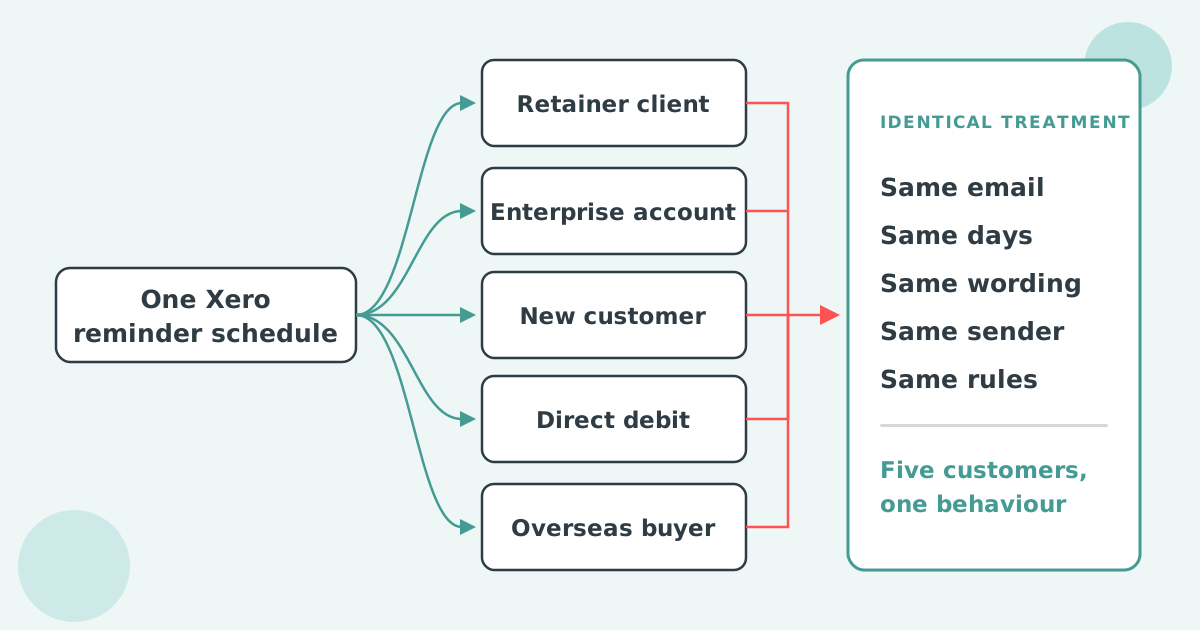
That list is where most guides stop. The reminder schedule is organisation-wide, so your best customer and your slowest payer get the same five emails on the same days. The native controls are a minimum amount, and an on-off switch per contact and per invoice. There is no second schedule. Statements exist but go out by hand. There is no interest, no payment plan, no dispute flag and no escalation trigger. Xero's own reminder guide points readers to the App Store for more.
One framing point for a US reader. QuickBooks holds most of the US small business market and Xero holds a single-digit share, so most US receivables platforms are built QuickBooks-first and add Xero second. Two US-native ones that do connect, Bill360 and Paystand, are payments platforms with reminders around them: card and ACH processing priced per transaction, no published late fee or instalment features. They belong on a shortlist when processing cost is the problem, and they sit outside the six below for that reason. The QuickBooks version is best accounts receivable software for QuickBooks.
An accounts receivable process has twelve jobs, from credit terms to collections handover. Xero does five of them well, does three partially, and leaves four to an app: late fees, payment plans, escalation and dispute handling.
| Job | What Xero does | Where it stops |
|---|---|---|
| 1. Credit terms and limits | Payment terms per contact, a credit limit per customer, and an optional hard block on new invoices once the limit is reached | No credit checks, no onboarding workflow, no automatic review of a limit against payment behavior |
| 2. Invoicing | Standard, repeating and online invoices | Out of scope here. Xero's invoicing is complete |
| 3. Delivery | Sends invoices and reminders from Xero's own infrastructure | No documented sending-domain authentication for reminders |
| 4. Reminders | Up to five, email only, one schedule for the whole organisation, a minimum-amount filter, and reminders switched off per contact or per invoice | No SMS, no per-customer-group schedule, no interest, no sixth email |
| 5. Statements | Manual, one at a time or in a batch, on demand | No schedule. Someone has to remember |
| 6. Dispute handling | Nothing native | An open, undeveloped Xero product idea. Tags are the common workaround |
| 7. Late fees and interest | Nothing native. No flat fee, no percentage, no compounding | A product idea open since 29 March 2012, 1,112 votes, status Accepted, no committed plans |
| 8. Payment options and portal | Pay now button, Stripe and GoCardless, payment auto-matched to the invoice | Payment is invoice by invoice. No account-level portal showing the whole balance |
| 9. Payment plans | Part payments against one invoice, and a one-off deposit via Stripe | No installment schedule, no per-installment reminder, no automatic installment collection |
| 10. Escalation | Nothing native | No trigger at N days overdue, no stop-credit action, no named owner |
| 11. Allocation and reconciliation | Bank reconciliation and payment matching, including processing fees | Xero's strongest receivables capability. Nothing to add |
| 12. Reporting, DSO and collections handover | Aged Receivables Summary and Detail, a debtor days ratio in the Executive Summary | No single DSO report, no trend without manual tracking, no handover to a collections agency |
Job 7 is the clearest line. The Xero product idea Add interest to late invoices was posted on 29 March 2012, carried 1,112 votes in September 2026 with a status of Accepted, and Xero's latest reply, on 7 July 2025, said there were no committed plans. Fourteen years is a long time for a thousand-vote request to sit open.
Read the table by column three. Jobs 3, 4, 5 and 8 are partial, and an app improves them. Jobs 7, 9 and 10 are empty in Xero, and an app is the only way to do them. Job 6, disputes, is empty in Xero and thin across all six apps, so expect to keep handling those in your inbox. Jobs 1 and 12 have credit-data and DSO gaps that only some apps fill. Jobs 2 and 11 are Xero's, and no app on this list tries to replace them.
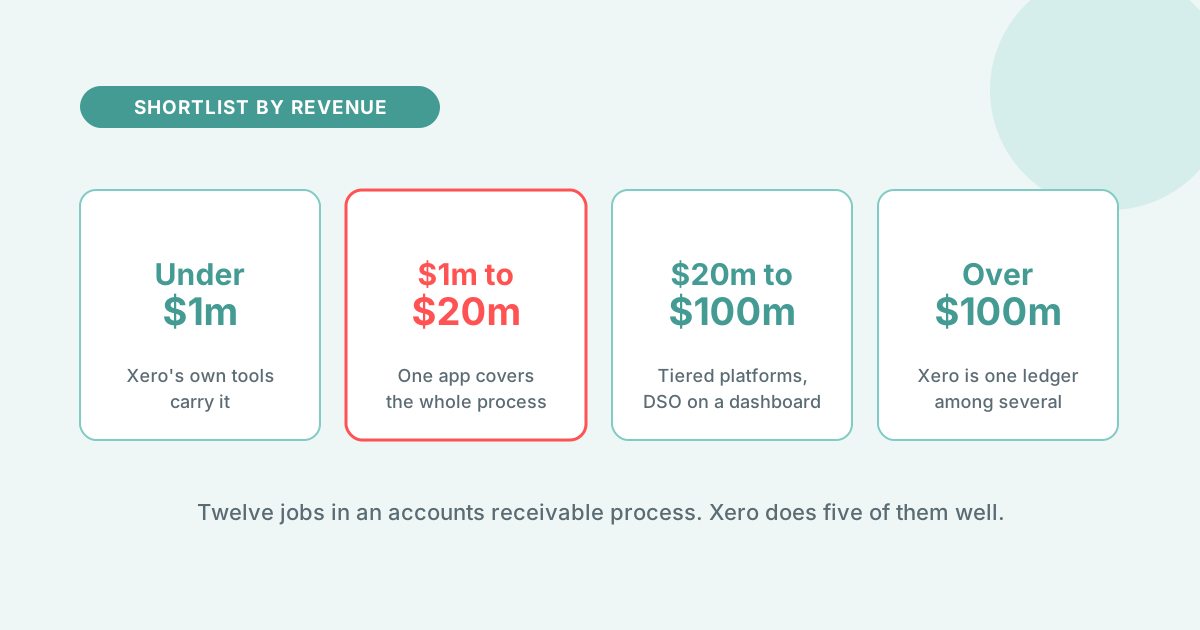
Annual revenue is the fastest filter. Under US$1m, Xero's own tools carry most of the load. From US$1m to US$20m the shortlist is Paidnice and Chaser. Above US$20m, the tiered platforms take over.
The bands come from each vendor's own published gates. Chaser caps its tiers at £4m, £10m and £100m of revenue. Kolleno gates at over US$1m and over US$10m of turnover. Upflow tiers by annual gross invoice value, US$10m to over US$100m, which is billing volume rather than revenue. Biller Genie's 0.50% fee stops growing at US$300,000 collected a month. Paidnice's fit is US$1m to US$20m, priced by invoice volume, not revenue.
| Annual revenue | What changes at this size | Apps to shortlist |
|---|---|---|
| Under US$1m | A few dozen invoices a month. Xero's five reminders and a statement run by hand cover most of it. An app pays for itself once the overdue list stops shrinking between runs |   Xero's own tools first. Biller Genie if you are US-based and paid by card. Paidnice Essentials at US$69 once statements need a schedule Xero's own tools first. Biller Genie if you are US-based and paid by card. Paidnice Essentials at US$69 once statements need a schedule |
| US$1m to US$20m | Hundreds of invoices a month, customer groups that need different cadences, statements on a schedule, and terms you intend to enforce. One plan covering the whole process matters more than any single feature |  Paidnice across the whole band. Chaser Compact under £4m and Core under £10m, if you need credit checks. Biller Genie for US card-heavy businesses at the low end, until its fee cap Paidnice across the whole band. Chaser Compact under £4m and Core under £10m, if you need credit checks. Biller Genie for US card-heavy businesses at the low end, until its fee cap |
| US$20m to US$100m | Several entities, a finance team with named senders, and DSO on a board dashboard. Credit data and cash application start to matter as much as chasing |   Chaser Complete under £100m. Upflow Grow to Accelerate, US$25m to US$100m gross invoice value. Kolleno above its US$10m turnover gate Chaser Complete under £100m. Upflow Grow to Accelerate, US$25m to US$100m gross invoice value. Kolleno above its US$10m turnover gate |
| Over US$100m | Xero is one ledger among several. Billing breadth, multi-entity analytics and allocation outweigh chasing |  Upflow Enterprise over US$100m gross invoice value. Invoiced for enterprise billing. Kolleno where NetSuite or SAP is the main ledger Upflow Enterprise over US$100m gross invoice value. Invoiced for enterprise billing. Kolleno where NetSuite or SAP is the main ledger |
Six apps, each with the revenue band it fits and the two or three features that matter at that size. Paidnice first, then Chaser, Biller Genie, Upflow, Invoiced and Kolleno. Prices are published US dollar figures, read in September 2026.
US$1m to US$20m a year on Xero, and the entry point below it
Three features decide it at this size: reminders by email and SMS from your own domain, statements on a weekly or monthly schedule, and late fees or interest posted into Xero as invoices. Payment plans, a card and ACH portal and escalation sit in the same plan. Fees are optional. Plenty of customers run reminders and statements only.
The limitation. No credit checks: no bureau data, no third-party risk score, no monitoring feed. No dispute flag on an invoice. Native support is Xero and QuickBooks Online only, so a NetSuite or Sage business belongs on the Custom plan or elsewhere on this list. Sending from your own domain is a Pro feature.
Best for: a US or Canadian Xero business between US$1m and US$20m that wants the terms on its invoices enforced without hiring for it.
US$1m to US$100m, with Chaser's own revenue caps of £4m, £10m and £100m on its three tiers
Credit checking and monitoring beside the chasing is the reason to pay Chaser's price at this size. The reminders, payment plans, portal and collections suite are solid and priced in US dollars. The interest engine is built around UK rates and stays that way.
The limitation. Revenue pricing means a low-volume, high-value business can pay US$779 a month for a few dozen invoices. The late fee rule is global rather than per customer group. Nothing published covers Canadian EFT or Interac.
Best for: a US B2B business between US$1m and US$100m that needs credit data as much as chasing.
Small US businesses under a few million in revenue, paid mostly by card
A US payments stack, a portal with autopay and a flat late fee from 30 days past due, on one bill of US$49.95 a month plus 0.50% of what you collect. At this size one vendor for reminders and processing beats two. Independent listings put its top rate cut-in around US$100,000 collected a month, where its Corporate tier is said to start. Biller Genie does not publish this itself.
The limitation. One reminder cadence for the whole account. No SMS, and paper reminders cost US$1.50 each. The Xero review record is three reviews, one describing a duplicate-charge sync problem, so test the Xero side on a small customer group first.
Best for: a US business under a few million that would otherwise buy a payments processor and a reminder tool separately.
US$10m to over US$100m in annual gross invoice value, which is billing volume, not revenue
DSO, collection effectiveness and at-risk receivables on a dashboard a board will read, across several entities, with a portal and cash application around it. No fees and no installment plans, so it suits a team past US$20m that handles those in the ledger.
The limitation. Automated actions fire once a day at a fixed time, on business days only. No fees, no installment plans, and statements are not documented. Every price is a sales conversation.
Best for: a multi-entity B2B team above US$20m that wants collections and board reporting on one platform.
Enterprise, over US$100m, with Xero as one ledger among several
Billing breadth across Xero, three QuickBooks editions and other systems, a published late fee automation page, and quote-only pricing. Owned by Flywire and positioned for enterprise, so a small Xero business is not who it is aimed at.
The limitation. Pricing, review record and the detailed feature inventory were not verifiable, so it appears as an option that exists and integrates rather than a checked recommendation. Ask for the Xero-specific demo.
Best for: a US enterprise with Xero somewhere in the estate and a billing problem bigger than a chasing problem.
Finance teams over US$10m turnover whose problem is matching payments, at US$650 per user
Cash application first: bank file formats, remittance parsing and multi-currency reconciliation, with chasing and credit risk as modules beside it. Kolleno gates its tiers at over US$1m and over US$10m turnover, and at US$650 per user the price only makes sense at the upper gate.
The limitation. Per-user pricing punishes the setup that works best in collections, which is several named senders escalating an invoice as it ages. A team of three starts near US$2,000 a month before processing.
Best for: a finance team above US$10m whose bottleneck is allocation, with NetSuite or SAP in the stack and Xero as a subsidiary ledger.
Two names come up constantly in receivables shortlists and neither is built for North America. Satago is UK only and Sage 50 shaped. ezyCollect is Australian and New Zealand, priced in Australian dollars and built around ERPs.
Both are good products at home. Satago bundles credit reports and single-invoice finance for UK businesses, and is covered in the UK guide to credit control software for Xero. ezyCollect serves Australian and New Zealand distributors with an ERP in the stack, and it appears in the guides to debtor management software in Australia and debtor management software in New Zealand. Neither publishes a US or Canadian price.
ConnectBooster is a payments and autopay portal for managed service providers running ConnectWise, Autotask or Kaseya BMS. It connects to Xero and publishes US ACH and Canadian EFT rates. It is not a general receivables tool.
If you are an MSP with a PSA in the stack, it deserves a look for autopay and reconciliation, and it is the one vendor here that names a Canadian EFT rate. It has no late fees, no interest and no installment plans, and its pricing is quote only across three separate bills. Everyone else should skip it. The MSP-specific comparison is in best credit control software for MSPs.
No US federal law sets a late payment rate between private businesses. Your contract does, within your state's usury ceiling. In Canada, the Interest Act caps an undisclosed monthly rate at 5% a year. Neither country hands you a number; the UK does.
United States. The one federal late payment statute, the Prompt Payment Act, applies only when the federal government is the buyer. Between two private businesses the right to charge a late fee or interest exists only if your written terms say so. Without a clause, you cannot add it afterward.
One more US point. In many states the usury cap only applies to loans, not to trade credit like an unpaid invoice. The test a court actually applies to a late fee clause is different: is the fee a reasonable estimate of what late payment costs you, or is it set high enough to frighten the customer into paying on time? The first is enforceable. The second is a penalty and a court can strike it, even if it sits under your state usury cap. Set a rate you can defend as a real cost estimate.
State usury law sets the outer ceiling, and most states exempt or lightly regulate B2B transactions. Many set no specific cap on a commercial late fee beyond a reasonableness standard, and where a ceiling exists it usually lifts for commercial deals above a dollar threshold. The small business convention is 1.5% a month, about 18% a year, inside most state ceilings once B2B exemptions apply. Check your state first.
Canada. The right to charge still comes from the contract. The rule that catches people is section 4 of the Interest Act. Terms that state a rate for a period shorter than a year, such as 2% a month, must also state the equivalent annual rate or a formula for it. Otherwise recoverable interest is capped at 5% a year. The clause is not void; it is cut down.
One more Canadian point. Separately from the Interest Act, the Criminal Code sets a criminal rate of interest: 35% a year, since 1 January 2025, down from roughly 48%. It covers fees and penalties tied to the credit, not just a stated percentage rate, so a compounding late fee counts. It does not apply to agreements advancing more than C$500,000 to a business. Most invoices are nowhere near that ceiling, but a high compounding rate on a large balance is worth checking against it.
A flat dollar late fee is not interest in the sense section 4 cares about, since it does not state a rate. That does not make it automatically safe: a court can still cut down a flat fee as a penalty if it looks more like a threat than a genuine estimate of your cost from late payment. Keep both rules in mind.
That matters for anyone who copies a US late fee clause into a Canadian contract. "1.5% per month" on its own fails the test. "1.5% per month, 18% per annum" passes. The Ontario Court of Appeal has accepted a formula in place of a stated annual figure, so the wording has some room, but the safest fix is to write the annual rate down.
Prejudgment interest is a different thing. A court adds it at judgment, each province sets it, and it does not apply to an overdue invoice in your ledger today. Ontario sets its rates under the Courts of Justice Act. British Columbia's Court Order Interest Act ties its rate to the prime lending rate, reset on 1 January and 1 July. Keep it separate from your contractual fee.
This section is general information, not legal advice. Check your state or province, and your own contract wording, before you rely on any of it.
For contrast, the UK gives you a statutory number: 8% over the Bank of England base rate, 11.75% for the half-year from 1 July 2026, with no clause required.
None of the six apps above, Paidnice included, calculates a state-specific or province-specific rate for you. Paidnice's late fee mechanics are jurisdiction-agnostic: you set the rate your contract allows, choose a grace period, decide whether interest compounds, and the charge posts into Xero and recalculates when the statement goes out. The legal work is yours, and it is done once, in your terms.
Two payment notes for this market. In the US, ACH costs a flat fee under a dollar per transaction against 1.5% to 3.5% for a card, and B2B ACH volume grew 9.9% in 2025 to 8.1 billion payments, according to Nacha. Offer both, and steer larger invoices to ACH.
In Canada, the batch bank rail is EFT and the fast ad hoc rail is Interac e-Transfer, not ACH. Ask each vendor which Canadian rails its portal supports, because only ConnectBooster publishes a Canadian EFT rate.
One table: the revenue band each app fits, how it connects to Xero, whether it charges late fees, whether it runs payment plans, and the published US dollar price. Row order follows the shortlist above.
| App | Best for | Xero integration | Late fees | Payment plans | Published price (USD) |
|---|---|---|---|---|---|
| Paidnice | US$1m to US$20m, the whole process in one plan, priced by invoice volume | Native, fees post to ledger | Flat, % or compounding, per group | Yes, Pro | $69/mo |
| Chaser | US$1m to US$100m B2B needing credit checks, tiers capped at £4m, £10m, £100m | Yes, US App Store | One global rule, UK-built | Yes | $259/mo |
| Biller Genie | US small business under a few million, card payments, one vendor for AR and processing | Yes, QuickBooks-first | Flat, from 30 days late | Customer-requested only | From $19.95/mo + 1.00%, third-party sourced |
| Upflow | US$10m to over US$100m gross invoice value, multi-entity DSO analytics | Yes, all tiers | Ledger side only | Promise to pay only | Quote only |
| Invoiced | Enterprise over US$100m, billing across several ledgers | Yes | Yes, no jurisdiction rules | Not published | Quote only |
| Kolleno | Finance teams over US$10m turnover where cash application is the problem | Yes, two tiers | Not found | Not published | $650 per user/mo |
"Not published" means the vendor documents nothing either way. "Not found" means the feature is absent from their documentation. The late fees column is the one to read twice: two of the six compute a fee inside the product, one hands the job to your ledger, and none of them, Paidnice included, knows your state or province.
Start from your annual revenue, then check the one feature that matters most at that size. Under US$1m it is cost. From US$1m to US$20m it is coverage in one plan. Above US$20m it is analytics, credit data or cash application.
Under US$1m. Run Xero's five reminders, a Pay now button and a statement by hand on the first of the month. If you are US-based and paid mostly by card, Biller Genie bundles processing with reminders for US$49.95 plus a percentage. When statements need a schedule, Paidnice Essentials at US$69 covers reminders and statements with fees left off.
US$1m to US$20m. Look for statements on a schedule, reminders that vary by customer group, late fees you can switch on later, and payment plans in the base product. Paidnice covers all of it from US$69, priced by invoice volume. Add Chaser to the shortlist if you extend credit to accounts you cannot vet, since credit data is the job the lower-priced apps do not do.
US$20m to US$100m. Several entities and a finance team change the question. Upflow puts DSO and at-risk receivables on a board dashboard, tiered by gross invoice value. Chaser Complete carries credit monitoring to £100m. Kolleno fixes allocation when payments arrive and nobody can match them. Confirm whether fees and plans matter before you accept their absence.
Over US$100m. Xero is one ledger among several, and the buy is billing breadth or enterprise analytics. Upflow Enterprise, Invoiced and Kolleno are the three that sell here, all quote only.
Canadian business at any size. Ask which Canadian bank rails the portal supports, and put the annual equivalent of your monthly rate in your terms before you switch on interest.
If you run several Xero organisations, the multi-entity question comes before the app question. Paidnice adds an entity for US$29 a month; Upflow and Kolleno are built for it; Biller Genie and Chaser are per organisation. If you need reminders and statements only and no fees at all, that is a complete setup on Paidnice, and it is how many customers run it.
Your annual revenue settles most of this. If you know it and still cannot place yourself in the table above, ask us and we will say which app fits, including when it is not ours.
Three of the six above do things Paidnice does not: credit checks, multi-entity board analytics and cash application at enterprise scale. When one of those is your problem, we will tell you.
Short answers to the questions US and Canadian Xero users ask about accounts receivable automation: what Xero does natively, what it costs to add an app, and what you can charge when an invoice is late.
Does Xero have accounts receivable automation built in?
Partly. Xero automates recurring invoices, up to five email reminders per organisation, online payment through a Pay now button and payment matching. Scheduled statements, late fees, payment plans, escalation and a customer portal need an app from the Xero App Store.
Which accounts receivable app should I choose for Xero?
It depends on your annual revenue. Between US$1m and US$20m, Paidnice covers the whole process in one plan priced by invoice volume, and Chaser adds credit checks. Under US$1m, Biller Genie suits US businesses paid by card. Above US$20m, Upflow, Kolleno and Invoiced sell tiered or quote-only platforms.
How much does accounts receivable automation for Xero cost?
Paidnice publishes US$69 a month and Chaser US$259. Kolleno is US$650 per user. Biller Genie no longer publishes a price on its own site, and third-party listings start it at US$19.95 a month plus a percentage of collections. Upflow and Invoiced quote only.
Can I charge late fees on invoices in the US?
Yes, if your written terms say so. There is no federal statute granting the right between private businesses, and state usury law sets the ceiling, with most states exempting or lightly regulating B2B. The common convention is 1.5% a month. Check your state before setting a rate.
Can I charge interest on overdue invoices in Canada?
Yes, if the contract provides for it. Under section 4 of the federal Interest Act, a rate stated for a period shorter than a year must also show the equivalent annual rate, or the recoverable interest is capped at 5% a year. Write "1.5% per month, 18% per annum", not "1.5% per month" alone.
Can Xero send customer statements automatically?
No. Xero generates statements for one customer or a batch and emails them on demand, but there is no schedule. An app such as Paidnice sends outstanding statements weekly or monthly on a chosen day, to customers with overdue invoices or to anyone with a balance.
Does Xero support payment plans?
Not as installment schedules. Xero records part payments against an invoice and can take a one-off deposit through Stripe. Splitting one invoice into scheduled installments, reminding per installment and charging each one automatically needs an app. Of the six here, Paidnice builds plans natively and Biller Genie approves customer-requested ones.
Which Xero add-ons charge late fees automatically?
Paidnice posts flat, percentage or compounding charges into Xero per customer group, with a grace period. Biller Genie applies a flat fee from 30 days past due. Chaser applies one global rule built around UK rates. Invoiced publishes a late fee page. None of them applies a state-specific or province-specific rate; you set the rate your contract allows.
Is ACH cheaper than card for paying invoices?
Yes. ACH typically costs a flat fee under a dollar per transaction, while cards cost roughly 1.5% to 3.5%. On a US$500 invoice that is a large difference. Most advice is to offer both and steer larger or recurring invoices to ACH. In Canada the equivalent rails are EFT and Interac e-Transfer.
Paidnice is accounts receivable automation that enforces your payment terms, trusted by thousands of businesses on Xero and QuickBooks. Credit control and debtor management, run for you.
Try it Now - It's FreeNo card required.



Optimize your cash flow with our suite of financial tools designed for AR professionals. Calculate DSO, aging analysis, late fees, and more.