


Summary
A credit control team works when every customer account has one owner, every customer reply has one person answering it, and one manager approves credit, stop-credit and write-off decisions. In a team of two to four, people hold several roles, so write down who owns each task and review it weekly with a few numbers per role.
- The roles: Credit control manager, credit controllers who own accounts, and someone covering cash allocation and queries. In a small team one person often holds two of these.
- KPIs by role: Managers own DSO, CEI and bad debt. Controllers own reach rate, promises kept and days to close. Whoever handles queries owns reply response time.
- The weekly review: Thirty minutes on broken promises, late escalations, open replies and who is overloaded, with one owner and one date for every account discussed.
Your business has grown past one person chasing invoices. Now two people make calls, a third allocates payments, and customer replies land in whichever inbox the reminder came from. A finance director we spoke to wanted a shared inbox for exactly this reason: collection emails went to one named person, so nobody else could see them.
Here is how to split the work in a credit control team, who owns what, the KPIs that fit each role, and the weekly review that holds it together.
Free: Payment reminder email templatesCopy the reminder emails for before, on and after the due date.What does a credit control team do?
A credit control team decides who gets credit and on what terms, makes sure invoices are paid on time, follows up the ones that are not, and handles disputes and queries along the way. In a small business the same team usually also allocates payments in the ledger.
The credit control process runs in this order:
- Check a new customer and set a credit limit and terms.
- Send accurate invoices with clear payment details.
- Remind before the due date and on it.
- Follow up overdue invoices by email, SMS and phone.
- Answer queries and disputes, and record promises to pay.
- Escalate: stop credit, a formal letter, a payment plan or a collection agency.
- Allocate payments and report on the ledger.
What are the roles in a credit control team?
A credit control team has three core roles: a manager who sets policy and makes the hard decisions, credit controllers who own customer accounts, and someone who handles cash allocation and queries. Larger teams split controllers into junior and senior by account size.
| Role | Owns | Decides |
|---|---|---|
| Credit control manager | Credit policy, reminder rules, the weekly review | Credit limits, stop credit, payment plans, write-offs, agency referrals |
| Senior credit controller | The largest and most difficult accounts, disputes | Promise dates and escalations on their accounts |
| Credit controller | A set of customer accounts or a customer group | Follow-up order and promise dates on their accounts |
| Cash allocation and queries | Matching payments, answering copy invoice and remittance requests | Which invoice a payment belongs to |
In a team of two to four, people hold more than one role. The manager may also own the top ten accounts, and a controller may allocate cash every morning. That is fine, as long as each task has a named owner.
How should you split accounts between credit controllers?
Split accounts by customer or customer group, not by aging bucket. When an account moves between people as it ages, nobody knows the customer and every call starts from scratch.
- By customer group: one controller owns trade customers, another owns contract or public sector customers. This works when groups need different terms or tone.
- By size: a senior controller owns the largest accounts, others share the rest.
- By entity: in a group of companies, each controller works one or more entities.
One team we spoke to runs each credit controller on their own ledger login, linked to different client companies. The cost is visibility: without a shared report, the manager waits a week to see what each controller has done.
Who should answer customer replies?
The person who owns the account should answer the customer's replies, and every reply should be visible to the whole team. A reply such as "paid last week" or "can you resend the invoice" needs an answer within hours, even when its owner is on leave.
Teams without a shared inbox find workarounds. One customer ran collections from a shared Gmail inbox with labels and stars, and a separate task tool beside it. That works until two people answer the same email, or nobody does.
Set three rules: every reply gets an owner, internal notes stay on the customer's record rather than in private email, and a reply is resolved only when the customer has their answer.
Who approves what in a credit control team?
The manager approves anything that changes the customer relationship or the ledger: credit limits, stop credit, payment plans, write-offs and agency referrals. Controllers should be able to agree a promise date on their own accounts without asking.
New starters are the exception. Until they know your customers, route their outgoing messages to the manager for approval before anything reaches a customer. Managers who only read reports, such as a finance director or the owner, need view-only access rather than full rights.
What KPIs fit each credit control role?
Give each role KPIs that its owner can actually move. Company numbers depend on sales and terms, so they belong to the manager, not to one controller.
| Role | KPIs |
|---|---|
| Credit control manager | DSO, collection effectiveness index, overdue balance, bad debt written off |
| Credit controllers | Reach rate on calls, amount promised, promises kept rate, median days to close escalations |
| Cash allocation and queries | Payments allocated within a day, open replies, queries resolved |
For how to read each controller's numbers fairly, see how to measure a credit controller's performance. For promises in detail, see tracking promises kept and broken for each collector.
What should a credit control team review each week?
Review broken promises, escalations past their date, open customer replies and each person's workload, in about 30 minutes. Every account discussed leaves with one owner and one next date. The full agenda is in the weekly AR team review.
How does Paidnice support a credit control team?
Paidnice gives each account an owner, puts every customer reply in one shared inbox, and shows what each person did in Team Activity. The shared inbox and Team Activity are on every plan.
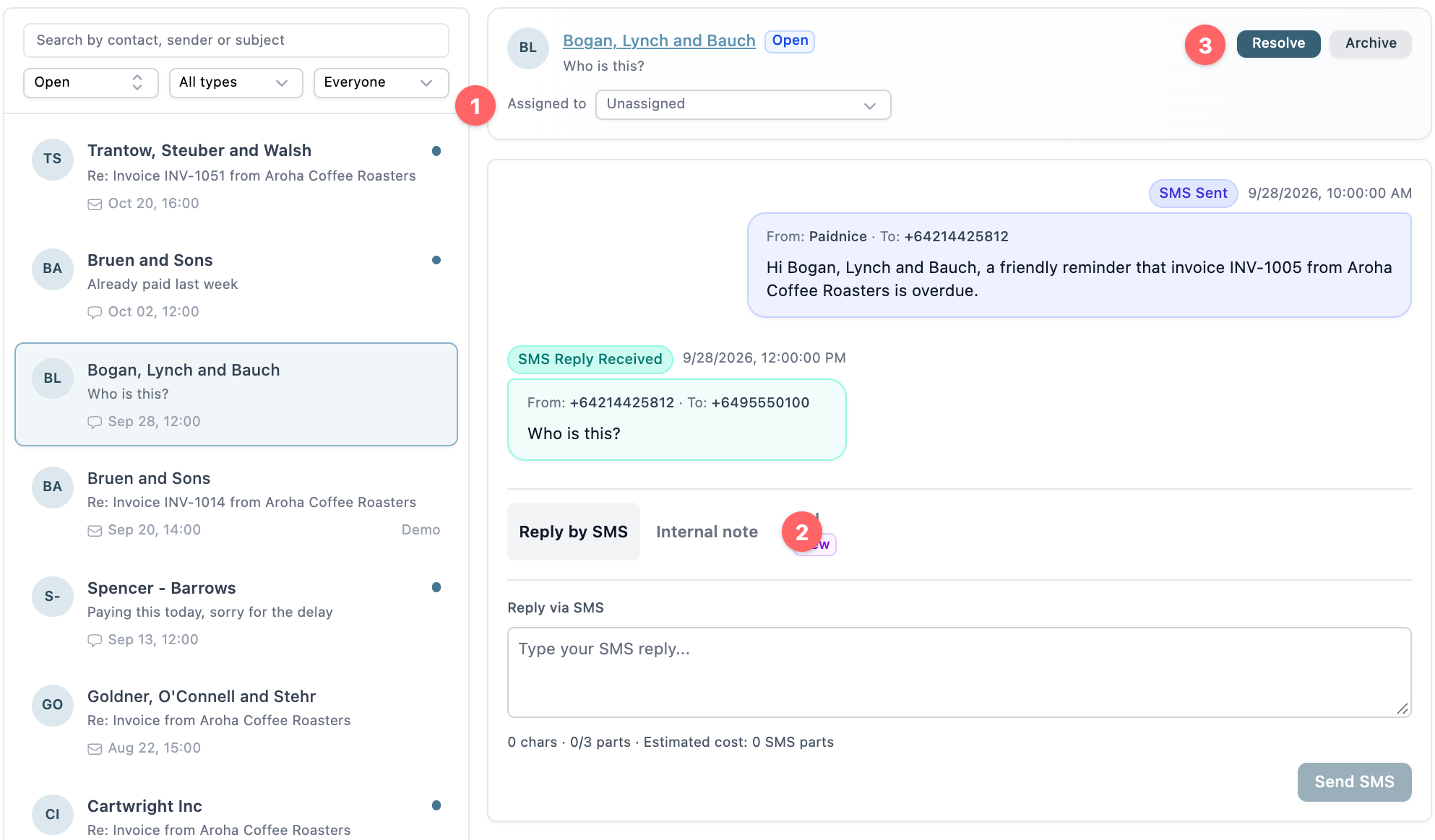
- Assigned to: each email or SMS reply gets an owner, and the list filters by Open, type and person.
- Internal note: notes stay on the conversation, and mentioning a teammate notifies them.
- Resolve: close the conversation when the customer has their answer, or archive it.
- Account owners: assign contacts or whole customer groups to team members. A user can be limited to the customers assigned to them.
- Approvals and roles: route a new user's sends to an approver before they reach customers, give managers a view-only role, and limit users to the entities they work.
- Team Activity: calls, reach rate, talk time, texts, promises kept and broken, queries resolved, escalations closed and median days to close, per person. See Team Activity.
💡 Paidnice insight
You can also assign accounts to an AI agent. It is a user in Paidnice with its own rules, so it can work the routine accounts while your controllers take the disputes and the largest customers.
If nobody in your business does credit control full time, start with credit control when it is nobody's job.
Frequently asked questions
How many credit controllers do I need?
It depends on how many active accounts you have and how much of the routine follow-up is automated. Start by automating reminders and statements, then size the team to the calls, disputes and promises that still need a person.
What is the difference between a credit controller and a credit control manager?
A credit controller owns customer accounts and chases payment. A credit control manager sets credit policy, approves limits, payment plans and write-offs, and runs the weekly review.
Should credit controllers own accounts or aging buckets?
Accounts. When one person owns a customer from invoice to payment, they know the history and the right contact. Splitting by aging bucket hands the customer to a stranger just as the invoice gets harder to collect.
Who covers when a credit controller is on holiday?
Name a cover person for each controller in advance. With replies in a shared inbox and notes on each customer's record, cover can pick up the account without forwarding emails.
Will AI replace a credit control team?
AI can write reminders, read replies and work routine accounts. A person still decides on credit, disputes, hardship and the largest customers. See will AI replace credit controllers.
Paidnice features in this article
About the editorial team
Ashley is a co-founder and lead developer of Paidnice and has built accounting software for more than 10 years. He builds the ledger connections that put reminders, late fees and payments into Xero, QuickBooks and ERPs such as NetSuite and Business Central. Before Paidnice he co-founded A2X, ecommerce accounting software for Xero and QuickBooks.

 App of the Year