


Summary
The person who manages the customer's account should answer their replies to invoice reminders. Give every reply one named owner, send disputes and payment plan requests to whoever can approve them, and name a backup who covers when the owner is out.
- Default owner: The account owner: the person assigned to that customer or customer group.
- When to hand over: Disputes, credit notes, payment plans and credit holds go to the person with authority to decide.
- When the owner is away: A named backup works the unassigned and out-of-office lists every day.
A customer replies to a reminder asking to split the invoice into two payments. Your bookkeeper says yes by email. Then your credit controller, who did not see that reply, phones the same customer and asks for the full amount by Friday.
Here is who should own each reply, how to split replies in a team of one, two or five, what to do when the owner is away, and how to stop two people answering the same customer.
Free: Payment reminder email templatesCopy the reminder emails for before, on and after the due date.Who should answer customer replies to invoice reminders?
The person who manages the customer's account should answer replies from that customer. They know the history, the promises already made and the tone that works with that customer.
The rule that matters most is one owner per reply. If nobody is named, the customer gets either no answer or two different ones.
What are the ways to split replies across a team?
There are three common ways to split replies. Most teams use the first and borrow from the second.
| Split | How it works | Best for | Watch out for |
|---|---|---|---|
| By account | Each customer or customer group has an owner, who answers all its replies | Teams of 2 or more with steady customers | Owner on leave with no backup |
| By reply type | Promises go to the collector, PO requests to billing, disputes to a manager | Teams where one person approves credits | Customer talks to three people about one invoice |
| By rota | One person works the whole inbox each day | Small teams sharing AR with other jobs | Nobody owns the follow-up next week |
A team that runs each credit controller on a separate set of client companies already splits by account. One such team told us that without a shared view, a manager waited a week to see what each controller had done.
Which replies should go to someone else?
Replies that need a decision the owner cannot make should go to someone who can. Hand them over with a note, and keep the owner on the conversation so the customer hears from one voice.
- Disputes. "The job isn't finished" or "the amount is wrong" goes to whoever can approve a credit note. Our guide to handling a disputed invoice covers the steps.
- Payment plans. A request to split or delay goes to whoever sets payment terms.
- Hardship. "We're having financial difficulties" needs someone who can agree a plan or a hold.
- Credit holds. Stopping supply is a business decision, often with sales.
- Missing paperwork. A request for a PO number or a copy of the invoice goes to billing if billing is a different person.
Who answers in a team of one, two or five?
The answer changes with the size of the team, but every size needs an owner and a backup.
- One person. You own everything. Name a backup for leave, such as the owner or the bookkeeper, and give them access to the same inbox.
- Two people. Split customers between you by group, and each covers the other on leave. Keep disputes with whoever approves credits.
- Three to five people. Assign customer groups to each collector, send disputes to a manager, and have one person check the unassigned list every morning.
If nobody does AR full time, credit control without a credit controller covers which jobs to automate and which a person keeps.
What happens when the reply's owner is away?
When the owner is away, the backup works their open replies until they return, then hands each one back with a note. Without a named backup, replies to an absent owner wait for the whole leave.
Make the handover visible. Reassign the conversation, add a note saying what you told the customer, and assign it back when the owner returns.
How do you stop two people answering the same customer?
Stop double answers by assigning a reply before anyone writes back, and by talking about the reply in internal notes, not in a second email to the customer.
- Assign every new reply when you first read it, even if you are assigning it to yourself.
- Only the assignee writes to the customer.
- Anyone else adds an internal note and mentions the assignee. Our guide to internal notes and mentions shows what to write.
- Close the reply when the customer has an answer, so it leaves everyone's open list.
How does Paidnice give every reply an owner?
In the Paidnice shared inbox, each conversation has an "Assigned to" field. Pick the person who manages the account, and each person can filter the list to their own conversations.
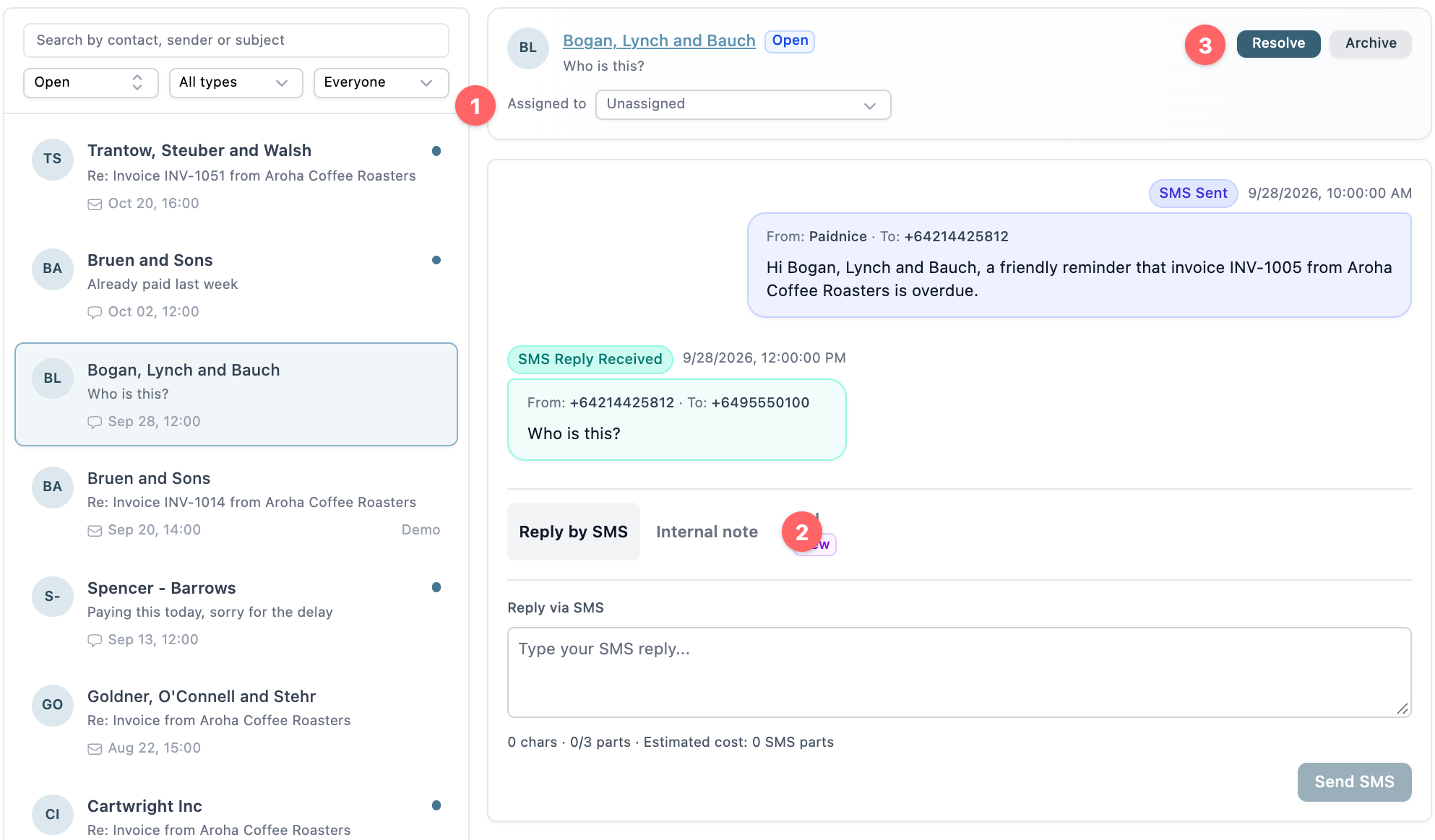
- Assigned to: the owner of this conversation. It starts as Unassigned until someone picks it up.
- Internal note: talk about the reply with the team. Mention a teammate and they are notified. The customer never sees it.
- Resolve: close the conversation when the customer has an answer.
You can also assign customers or whole groups to team members, limit a user to only the customers assigned to them, and send a new user's actions to an approver before they reach the customer. The approvals and roles page covers each control. Every plan includes the shared inbox.
💡 Paidnice insight
Most double answers come from good intentions: two people see a reply and both want to help. Assigning a reply the moment someone reads it removes the guesswork about who answers.
Frequently asked questions
Should the business owner answer replies to invoice reminders?
Only if they manage the customer. Owners are often the right person for disputes, hardship and large accounts, and the wrong person for routine "paid on Friday" replies.
Should sales answer replies about unpaid invoices?
Sales should know about a dispute or a credit hold on their customer, but finance should answer. Mention the salesperson in an internal note so they can add context without writing to the customer.
What if a reply comes in for a customer with no owner?
It goes to the unassigned list. Pick one person to clear that list every morning and assign each reply, then fix the gap by assigning the customer to an owner.
How do I make sure the backup sees the replies?
Give the backup access to the same shared inbox, not a forwarding rule from the owner's mailbox. A forwarding rule copies replies but not what the owner already said.
Paidnice features in this article
- Shared inbox Puts every customer reply by email and SMS in one inbox, where your team assigns, notes and answers it.
- Roles and approvals Assigns accounts to people or an AI agent and asks for approval before each action.
- Email and SMS reminders Sends reminders by email and SMS on your schedule, each with a link to pay.
About the editorial team
Ashley is a co-founder and lead developer of Paidnice and has built accounting software for more than 10 years. He builds the ledger connections that put reminders, late fees and payments into Xero, QuickBooks and ERPs such as NetSuite and Business Central. Before Paidnice he co-founded A2X, ecommerce accounting software for Xero and QuickBooks.
 App of the Year