

Summary
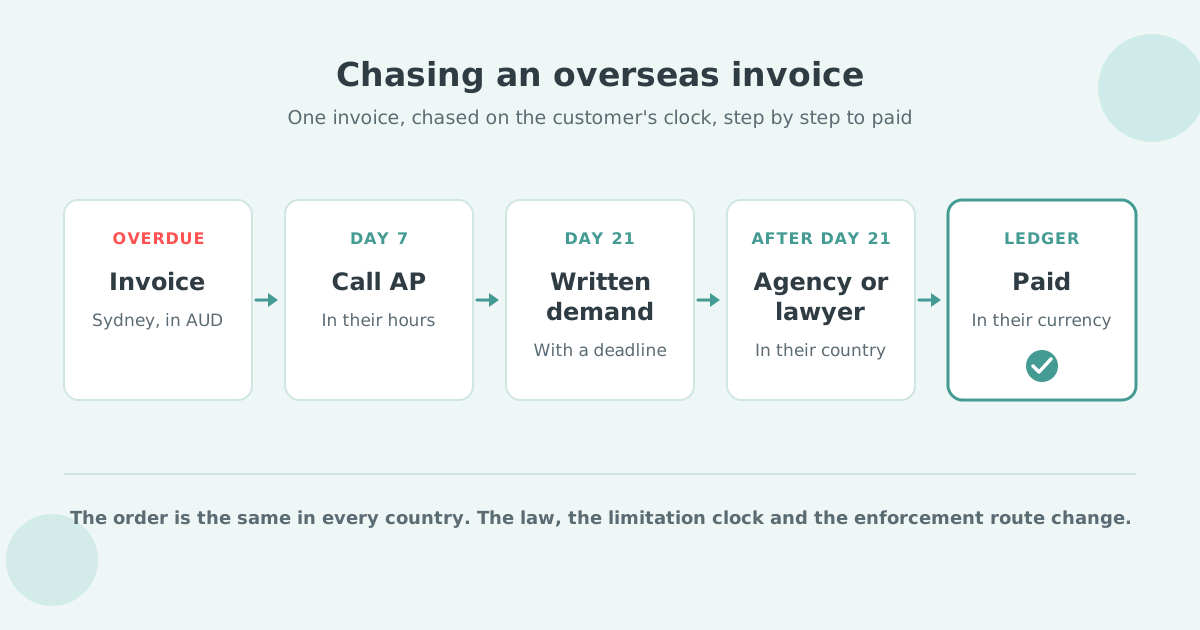
To chase unpaid invoices from overseas customers, follow the same order as a domestic debt: evidence pack, a check that the payment is not still in transit, reminders to the accounts payable team in their working hours, a written demand, then an agency or lawyer in their country. Three things change: the law, the limitation clock and the enforcement route.
- In transit or late: Swift reports that 90% of cross-border payments reach the destination bank within an hour, but only 43% reach the end customer's account that fast.
- The law: A contract under English law with a real UK connection keeps your right to statutory interest of 8% over Bank Rate (11.75% for debts arising from 1 July 2026); a contract under the buyer's law usually loses it.
- The fix: Paidnice runs the parts that repeat: a region group per market with its own send hour and wording, every invoice chased in its own currency, and escalations routed to any agency or solicitor in any country.
Your customer in Sydney replies that the payment went out on Tuesday and attaches a screenshot from their bank. Cross-border payments often reach your bank long before they reach your account, so the screenshot can be true while your account is still empty.
- Build the evidence pack. Signed contract or purchase order, the invoice with its due date and currency, proof of delivery, and every written promise to pay. The governing-law clause decides which country's rules apply.
- Check the payment is not still in transit. Ask for the bank's payment confirmation and its Swift tracking reference before you treat it as late.
- Chase the accounts payable team in their working hours. Find out whether the invoice is stuck on an admin error, disputed, or waiting for cash.
- Send a written demand at day 21. Invoice number, due date, balance in the invoice currency, a deadline, and interest only where the governing law or the contract allows it.
- Escalate in the customer's country. A collection agency first, local counsel where the sum justifies it. Limitation periods and the enforcement route differ by country.
What do you need before you chase unpaid invoices from overseas customers?
Before you chase unpaid invoices from overseas customers you need an evidence pack: the signed contract or purchase order, the invoice with its due date and currency, proof of delivery, and every written promise to pay.
Add two things a domestic chase can skip: the governing-law and jurisdiction clause, because the law, the limitation clock and the enforcement route all follow it, and the purchase order number with the legal entity it names, because an overseas payables team rejects an invoice addressed to the wrong company. Keep any portal upload confirmation as proof of receipt.
Is an overseas payment late, or still in transit?
An overseas payment can be sent and still not received for hours or days: Swift reports that 90% of cross-border payments reach the destination bank within an hour, but only 43% reach the end customer's account that fast.
Swift puts the gap down to checks at the receiving bank. So before you treat a payment as late, ask for the bank's payment confirmation (older banks call it an MT103) and its tracking reference, the UETR, a 36-character code that any bank in the chain can use to locate the payment.
If the customer cannot produce either after a day or two, treat the invoice as unpaid and carry on up the ladder.
Short payments are often bank fees. A charge code on the transfer decides who pays the banks: OUR means the sender pays all charges, SHA shares them, and BEN leaves them all to you. With SHA or BEN, intermediary fees come off the amount before it lands, so put OUR in your terms.
Who should you contact at an overseas customer?
Contact the customer's accounts payable team, not the person who ordered the work: the payables team runs the payment run and knows whether the invoice is stuck, disputed or waiting for cash.
Put the payables mailbox on the contact record, then find the cause with one question each:
- Admin error. Is the invoice approved and matched to a purchase order? Missing PO numbers, the wrong entity and the wrong currency are the usual blockers.
- Dispute. Is anything contested? Get it in writing and resolve it before you escalate.
- Cash flow. Which payment run is it in? Ask for a named payment run date and note it. Their payment record shows whether they met earlier ones.
When should you send each reminder to an overseas customer?
Send each reminder to an overseas customer in their working hours, on a fixed ladder that runs from a check three days before the due date to a written demand at day 21.
- Three days before due. Confirm the invoice is approved and in the next payment run, and ask for the run date.
- Due date. A reminder with a payment link in the invoice currency, to the payables mailbox.
- Day 7. A call to accounts payable in their hours. If they say it is paid, ask for the payment reference.
- Day 14. A statement of account, every open invoice in its own currency.
- Day 21. A written demand with a deadline, posted as well as emailed.
When it is 10am in London in January (GMT), the local time is:
| Customer city | Local time | Gap to London |
|---|---|---|
| New York | 5am | 5 hours behind |
| Los Angeles | 2am | 8 hours behind |
| Sydney | 9pm | 11 hours ahead |
| Auckland | 11pm | 13 hours ahead |
The gaps move twice a year, because the hemispheres change their clocks on different dates. Time zones decide the send hour, so schedule each reminder for the customer's morning and skip their public holidays. Set a send hour per region; the reminders by customer location guide shows how.
Which country's law applies to an overseas invoice?
The law that applies to an overseas invoice is the law named in the contract's governing-law clause, and the jurisdiction clause names the court.
Rome I, Article 3(1): "a contract shall be governed by the law chosen by the parties".
For a UK supplier the governing law decides whether the Late Payment of Commercial Debts (Interest) Act 1998 still applies. Section 12 answers in two parts:
"(1) This Act does not have effect in relation to a contract governed by the law of a part of the United Kingdom by choice of the parties if (a) there is no significant connection between the contract and that part of the United Kingdom; and (b) but for that choice, the applicable law would be a foreign law."
"(2) This Act has effect in relation to a contract governed by a foreign law by choice of the parties if (a) but for that choice, the applicable law would be the law of a part of the United Kingdom; and (b) there is no significant connection between the contract and any country other than that part of the United Kingdom."
A contract that names English or Scottish law keeps the Act where it has a significant UK connection. A contract under the buyer's law is usually outside it, unless that choice of law is the only foreign link. Where it is unclear, take advice from a lawyer in that country.
Inside the EU, Directive 2011/7/EU sets statutory interest at the central bank reference rate plus at least eight percentage points (Article 2(6)) and a fixed €40 per late payment (Article 6). Elsewhere, your contract decides, and local law can cap it.
What interest, time limit and enforcement route apply in each country?
The interest, time limit and enforcement route differ in each country: whether a statute sets interest, how many years you have to sue, and whether a UK money judgment can be registered or recognised without retrying the merits.
Hague 2019 and Hague 2005 are treaties on recognising court judgments across borders (each link opens the official list of countries that have joined); the US has signed both and ratified neither. UCC 2-725 is the US Uniform Commercial Code rule for sales of goods. "Extinguished" means the debt can no longer be claimed.
| Customer country | Statutory late interest | Limitation for a contract debt | Enforcing a UK money judgment there |
|---|---|---|---|
| England and Wales | 8% over Bank Rate (11.75% for debts arising 1 July to 31 December 2026) plus £40, £70 or £100 per invoice (UK late payment fees guide) | 6 years (Limitation Act 1980, s.5) | Home courts |
| Scotland | Same Act and rate | 5 years, then the obligation is extinguished (1973 Act, s.6) | Home courts |
| Ireland and the EU | Reference rate plus at least 8 points and €40 per late payment; Ireland uses the ECB rate plus 8 points | Ireland 6 years (Statute of Limitations 1957, s.11); other states vary | Hague Judgments Convention 2019 (not Denmark) for proceedings begun on or after 1 July 2025; Hague 2005 for one named court |
| United States | Contract and state law; the federal Prompt Payment Act covers federal agencies only | 4 years for a sale of goods (UCC 2-725); other contracts vary by state | Recognised by state courts under the Uniform Foreign-Country Money Judgments Recognition Act; merits not retried |
| Canada (Ontario) | Contract only; a monthly rate with no stated yearly equivalent is capped at 5% a year (Interest Act s.4) | 2 years from discovery (Limitations Act, 2002, s.4); other provinces vary | Register within 6 years: Reciprocal Enforcement of Judgments (U.K.) Act (Ontario) |
| Australia | Contract only | 6 years in most states; Northern Territory 3 years | Register within 6 years: Foreign Judgments Act 1991 (Cth) |
| New Zealand | Contract only | 6 years, raised as a defence by the debtor (Limitation Act 2010, s.11) | Register within 6 years: Reciprocal Enforcement of Judgments Act 1934 (NZ) |
| South Africa | A default statutory rate applies only where no agreement, trade custom or other law sets one | 3 years (Prescription Act 68 of 1969, s.11) | Court action on the UK judgment at common law (Jones v Krok); merits not reopened |
| Singapore | Contract only | 6 years (Limitation Act 1959, s.6) | Register within 6 years: Reciprocal Enforcement of Foreign Judgments Act 1959; Hague 2005 for one named court |
Which law sets the time limit, and will another country's courts accept a UK judgment?
The time limit for suing follows the law that governs the contract, not the country of the court. Rome I, Article 12(1)(d) puts "prescription and limitation of actions" under the governing law, and the Foreign Limitation Periods Act 1984 applies that foreign period in an English court.
The clock starts when payment fell due, or in some places when you knew, and a part payment or acknowledgement can restart it. Take advice from a lawyer in that country before you rely on a date.
Enforcement is the third difference. The European Payment Order and European Small Claims procedure are closed to UK claimants. The Hague Judgments Convention 2019 has applied to the UK since 1 July 2025, for proceedings begun on or after that date. It covers the EU and the other countries that have joined.
When should you send a written demand to an overseas customer?
Send a written demand to an overseas customer at day 21 overdue, once a call has confirmed the invoice is approved and undisputed. State the invoice number, due date, balance in the invoice currency and a deadline.
Claim interest and fixed sums only where the governing law or the contract allows them; a claim to a right you do not have gives the customer's lawyer an easy reply. Post it as well as emailing it. The letter before action template has the wording.
Should you use a collection agency or a lawyer in the customer's country?
Use a collection agency in the customer's country for most unpaid overseas invoices, and a lawyer there where the sum justifies a court case.
Hand the agency the whole evidence pack; the guide to when an invoice should go to an agency covers the handover.
If you hold trade credit insurance, report the default inside the policy's notification window first, which your policy schedule states. Insurers set their own deadlines to assess a claim; Atradius, for example, states 30 days. UK exporters can insure against non-payment through UK Export Finance's export insurance policy, which typically covers up to 95% of the loss.
Use local counsel last, and only where the sum justifies the cost. Where a registration statute or convention applies, a UK money judgment can be registered there. Elsewhere you sue on the judgment in a local court, which does not retry the merits but adds cost. Write off what costs more to recover than it is worth. The software versus agency comparison sets out where each fits.
How do you stop an overseas invoice going unpaid again?
To stop an overseas invoice going unpaid again, settle four things in writing before the next invoice: the governing law, the invoice currency and bank charges, staged payment on big jobs, and the customer's vendor onboarding.
- Governing law and court. Name them in the contract. They decide the interest you can claim, the limitation clock and where you enforce.
- Currency and charges. Invoice in one agreed currency and put the OUR charge code in the terms, so bank fees do not arrive as a short payment.
- Staged payment. On a first or high-value contract, take part of the price upfront and bill the rest in stages, so the open balance never equals the whole job. Where a customer cannot pay in one go, a payment plan with set instalments keeps the invoice moving.
- Vendor onboarding and PO. Complete the customer's vendor forms (bank details, tax numbers) when you win the work, and put their purchase order number on the first invoice.
How does Paidnice chase overseas customers?
Paidnice automates the repeating steps of the ladder above: a region group per market with its own send hour, every invoice chased in its own currency, and escalations routed to any agency or solicitor.
- A group per market. Each region group sets its own send hour, wording and sender, so the Australian group goes out on a Sydney morning.
- Chased in the invoice currency. Reminders, statements with one section per currency and fixed late fees all use the invoice currency, and every reminder carries a payment link.
- UK statutory interest where it applies. For contracts the Act covers, Paidnice adds base rate plus 8%, locked per six-month period or tracked, with the £40, £70 and £100 fixed sums on the ledger. For other contracts you set the rate your contract allows.
- Escalation to any agency or solicitor. An escalation fires at a chosen number of days overdue and routes to any collection agency or solicitor in any country.
- Posted demands. Paidnice can print and post the day 21 written demand for you in the UK, EU, USA, Canada, New Zealand, Australia, Singapore, Hong Kong and South Africa.
The reminder before the due date is easy to skip on overseas accounts, because the usual send time falls in the customer's night. Set the region group's send hour so it lands in their morning, and the customer payment portal shows the payables team every open invoice with a link to pay.
Common questions about chasing unpaid invoices from overseas customers
How long can you chase an unpaid invoice from an overseas customer?
As long as the limitation period under the law governing the contract: from 2 years from discovery in Ontario to 6 in England and Wales (see the table above). A part payment or acknowledgement can restart the clock; take advice from a lawyer in that country.
Can a UK business enforce a debt in Europe?
Yes, with a judgment. The European Payment Order and Small Claims routes are closed to UK claimants, but the Hague Judgments Convention 2019 has applied between the UK and the other contracting states since 1 July 2025, for proceedings begun on or after that date.
Which currency should an overseas invoice be in?
The currency the contract names, and chase in the same currency so the payables team can match the amount. Put the OUR charge code in the contract so bank fees do not arrive as a short payment.
Is it worth taking an overseas customer to court?
Only where the sum covers local counsel plus enforcement. Australia, New Zealand, Ontario and Singapore let you register a UK money judgment under a statute. South Africa and most US states recognise it through a court action that does not retry the merits. Each route has its own fees and defences, so try an agency in their country first.

 App of the Year